The substance library

ValproateResearch compound

Valproate influences several pathways involved in neuronal activity. Research examines its effects on learning, memory and brain function.

3 sourcesContent date Nov 1, 2026CompareExplore connectionsRevision history
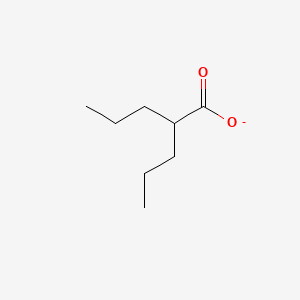
Valproate molecular structure
PubChem
01

Overview

Valproate influences several pathways involved in neuronal activity. Research examines its effects on learning, memory and brain function.

How it works

Explicit mechanistic or disposition finding (PMID 24733439)

Likewise, histopathologic examination revealed hepatocellular degeneration, replacement by inflammatory cells, focal pericentral necrosis, and micro/macrovesicular steatosis. [2]

Explicit mechanistic or disposition finding (PMID 24868521)

As a high correlation between salivary valproic acid levels and plasma ultrafiltrate levels was found in humans, saliva becomes a promising monitoring fluid in order to study valproic acid pharmacokinetics and its toxic effect. [3]
02

Doses & routes

Study doses and reference exposures, with route, formulation and duration.

Other routes · Other or unspecified · 2 records

PMID 24733439 study exposure: 500 mg/kg

Research exposure

500 mg/kg [2]

Ingredient / form
Valproate · Study formulation as stated in the abstract
Frequency
As stated in the abstract
Duration
Study duration as stated in the abstract
Population
METHODS AND RESULTS: VPA (500 mg/kg orally for 14 days in rats) evoked prominent hepatotoxicity that appeared as a marked rise (2- to 4-fold) in serum hepatic enzymes (γ-glutamyl transferase [γ-GT], alanine aminotransferase [ALT], and alkaline phosphatase [ALP]), increased hepatic lipid peroxide (LP
Purpose
Research exposure; not a general-use recommendation

METHODS AND RESULTS: VPA (500 mg/kg orally for 14 days in rats) evoked prominent hepatotoxicity that appeared as a marked rise (2- to 4-fold) in serum hepatic enzymes (γ-glutamyl transferase [γ-GT], alanine aminotransferase [ALT], and alkaline phosphatase Full text is available via PMC.

PMID 24733439 study exposure: 250 mg/kg

Research exposure

250 mg/kg [2]

Ingredient / form
Valproate · Study formulation as stated in the abstract
Frequency
As stated in the abstract
Duration
Study duration as stated in the abstract
Population
METHODS AND RESULTS: VPA (500 mg/kg orally for 14 days in rats) evoked prominent hepatotoxicity that appeared as a marked rise (2- to 4-fold) in serum hepatic enzymes (γ-glutamyl transferase [γ-GT], alanine aminotransferase [ALT], and alkaline phosphatase [ALP]), increased hepatic lipid peroxide (LP
Purpose
Research exposure; not a general-use recommendation

Concurrent treatment with DHA (250 mg/kg) markedly blunted the elevated levels of liver enzymes, lipid peroxides, TNFα, and MPO activity, while raising serum albumin and hepatic GSH levels Full text is available via PMC.

03

Pharmacokinetics

Absorption, metabolism and elimination depend on the analyte, route, formulation, physiology and other exposures.

Timing explorer

Published timing evidence
The source reports timing terms but does not provide numeric elapsed intervals.

Not established as a numeric timeline. Plasma timing and felt effects are distinct measurements. Source

Modeled elimination

The elimination model describes the named analyte after absorption and distribution. It does not establish felt-effect timing.

not-established

Not modeled

Elimination model

An elimination model is not established for this observation.

Source-bound record

This observation provides context about the measured record, but it does not support a first-order elimination curve.

Measured analyte
Valproate
Population
METHODS AND RESULTS: VPA (500 mg/kg orally for 14 days in rats) evoked prominent hepatotoxicity that appeared as a marked rise (2- to 4-fold) in serum hepatic enzymes (γ-glutamyl transferase [γ-GT], alanine aminotransferase [ALT], and alkaline phosphatase [ALP]), increased hepatic lipid peroxide (LP

Source context

Lastly, we also verified whether DHA may kinetically alter plasma levels/clearance rate of VPA.
Read source context
Review the supporting record and source details.

No validated elimination observation was imported in this corpus pass. [2]

Sourced elimination observations

Valproate

No numeric estimate

Not established [2]

Population
METHODS AND RESULTS: VPA (500 mg/kg orally for 14 days in rats) evoked prominent hepatotoxicity that appeared as a marked rise (2- to 4-fold) in serum hepatic enzymes (γ-glutamyl transferase [γ-GT], alanine aminotransferase [ALT], and alkaline phosphatase [ALP]), increased hepatic lipid peroxide (LP

Lastly, we also verified whether DHA may kinetically alter plasma levels/clearance rate of VPA.

Valproate

No numeric estimate

Not established [3]

It is extensively metabolized in liver, representing β -oxidation in the mitochondria one of its main metabolic route (40%).

04

Safety & uncertainty

Adverse effects and interactions reported in the cited studies.

Warning

Safety or adverse-event finding (PMID 24733439)

Thus, we currently first tested the ability of DHA to ameliorate valproate (VPA)-evoked hepatotoxicity, to modulate its anticonvulsant effects, then sought the cellular and molecular basis of such actions. [2]

Monitor

Safety or adverse-event finding (PMID 24868521)

As a high correlation between salivary valproic acid levels and plasma ultrafiltrate levels was found in humans, saliva becomes a promising monitoring fluid in order to study valproic acid pharmacokinetics and its toxic effect. [3]

Interactions in cited sources

Explore a pair of substances
05

Research & sources

3

Original publications, findings and available funding disclosures.

06

Publication history

Content updated Nov 1, 2026.