The substance library

MitragynineThe alkaloid, not the leaf.

Also known as: Kratom

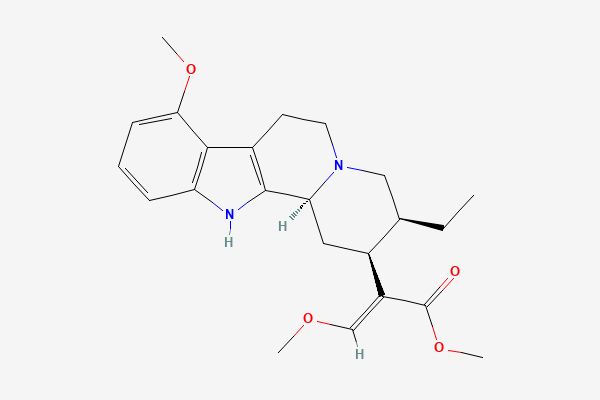
Mitragynine, PubChem CID 3034396, is kratom's primary alkaloid. A human study measured it in a kratom extract that was 39.5% mitragynine. The inspected abstract does not give a numeric half-life.

3 sourcesContent date Oct 3, 2026CompareExplore connectionsRevision history
Mitragynine molecular structure
PubChem
01

Overview

Searchers looking for kratom will land here on the alkaloid, not on a leaf, a tea, or a gram-of-plant dose. The pharmacokinetic doses below are milligrams of mitragynine in that extract. 7-hydroxymitragynine is a different constituent. The FDA states that it has substantially greater mu-opioid receptor potency than mitragynine and that it is under 2% of the alkaloid content of natural leaves.

How it works

Mu-opioid potency comparison

The FDA states that 7-hydroxymitragynine, less than 2% of leaf alkaloid content, has substantially greater mu-opioid receptor potency than mitragynine, and greater potency than classical opioids such as morphine. [2]

02

Doses & routes

Study doses and reference exposures, with route, formulation and duration.

Oral · By mouth · 3 records

Extract single dose, 9.9 mg mitragynine

Research exposure

9.9 mg [1]

Ingredient / form
Mitragynine in a kratom extract · Extract standardized to 39.5% mitragynine
Route
Oral
Frequency
Single dose, with a separate 15-dose series
Duration
Pharmacokinetic sampling in the cited study
Population
Human participants in the cited extract study
Purpose
Measure mitragynine and 7-hydroxymitragynine plasma concentrations

Single-dose mean Cmax 32.8±17.0 ng/mL. After 15 doses, mean Cmax was 27.4±10.9 ng/mL. This is not a weight of leaf.

Extract single dose, 29.6 mg mitragynine

Research exposure

29.6 mg [1]

Ingredient / form
Mitragynine in a kratom extract · Extract standardized to 39.5% mitragynine
Route
Oral
Frequency
Single dose, with a separate 15-dose series
Duration
Pharmacokinetic sampling in the cited study
Population
Human participants in the cited extract study
Purpose
Measure mitragynine and 7-hydroxymitragynine plasma concentrations

Single-dose mean Cmax 93.2±38.6 ng/mL. After 15 doses, mean Cmax was 125±79.7 ng/mL.

Extract single dose, 59.2 mg mitragynine

Research exposure

59.2 mg [1]

Ingredient / form
Mitragynine in a kratom extract · Extract standardized to 39.5% mitragynine
Route
Oral
Frequency
Single dose, with a separate 15-dose series
Duration
Pharmacokinetic sampling in the cited study
Population
Human participants in the cited extract study
Purpose
Measure mitragynine and 7-hydroxymitragynine plasma concentrations

Single-dose mean Cmax 196±77.4 ng/mL. After 15 doses, mean Cmax was 277±48.8 ng/mL.

03

Pharmacokinetics

Absorption, metabolism and elimination depend on the analyte, route, formulation, physiology and other exposures.

Timing explorer

Published timing evidence
The source reports timing terms but does not provide numeric elapsed intervals.
Peak
Median Tmax was 1.3 hours. Single-dose mean Cmax was 32.8±17.0, 93.2±38.6, and 196±77.4 ng/mL after 9.9, 29.6, and 59.2 mg mitragynine.

Not established as a numeric timeline. Plasma timing and felt effects are distinct measurements. Source

Modeled elimination

The elimination model describes the named analyte after absorption and distribution. It does not establish felt-effect timing.

Oral · Kratom extract standardized to 39.5% mitragynine · not-established

Not modeled

Elimination model

An elimination model is not established for this observation.

Source-bound record

This observation provides context about the measured record, but it does not support a first-order elimination curve.

Measured analyte
Mitragynine
Route
Oral
Formulation
Kratom extract standardized to 39.5% mitragynine
Population
Human participants in the cited single-dose and 15-dose extract study

Source context

No numeric elimination half-life is stated.
Read source context
Review the supporting record and source details.

The abstract says half-lives were best reflected at the higher doses but does not give a number. Reported Cmax and Tmax are exposure measurements. [1]

Sourced elimination observations

Mitragynine

No numeric estimate

Not established [1]

Route / formulation
Oral · Kratom extract standardized to 39.5% mitragynine
Population
Human participants in the cited single-dose and 15-dose extract study

No numeric elimination half-life is stated.

Metabolism / metabolites
Single-dose mean Cmax of 7-hydroxymitragynine was 6.8±2.7, 13.7±3.3, and 30.5±12.2 ng/mL at those three mitragynine amounts. After 15 doses, mitragynine mean Cmax was 27.4±10.9, 125±79.7, and 277±48.8 ng/mL. [1]
04

Safety & uncertainty

Adverse effects and interactions reported in the cited studies.

Warning

Kratom products are not approved medicines

The FDA warns consumers not to use kratom because of serious adverse events, including liver toxicity, seizures, and substance use disorder. That warning is about kratom products. The human concentration data are from a 39.5% mitragynine extract, not from pure mitragynine and not from a weighed leaf dose. [2]

Interactions in cited sources

Explore a pair of substances
05

Research & sources

3

Original publications, findings and available funding disclosures.

Reports elsewhere

This link leaves BHWiki for an outside experience index. It is not a finding, a dose, or a source for the claims above. The report text is not stored here.

06

Connected claims

Explore the participants, roles and sources behind each relationship.

receptor-potency-comparisonAuthored relationship

The FDA states that 7-hydroxymitragynine has substantially greater mu-opioid receptor potency than mitragynine.

FDA communication on kratom alkaloids, comparing 7-hydroxymitragynine with mitragynine

Limitation 7-hydroxymitragynine is not catalogued here as its own substance. The sentence is a potency comparison, not a controlled outcome of pure mitragynine.

Explore the relationship graph
08

Publication history

Content updated Oct 3, 2026.

Keep exploring

View graph