 Wikipedia
Stroop interference
DecreasedIn a randomized crossover study comparing dopamine agonists, bromocriptine reduced Stroop interference, while neither bromocriptine nor pergolide changed delayed-response working-memory errors. [5]
Human research
The substance library
Bromocriptine acts on dopamine receptors. Research explores how it affects working memory and cognitive flexibility.
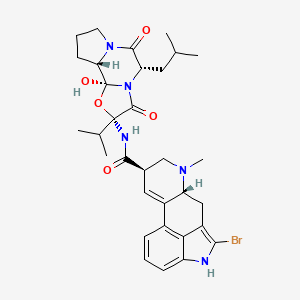
Human studies include a 1.25 mg crossover trial showing improved spatial memory span but impaired probabilistic reversal learning, a study where bromocriptine reduced Stroop interference without improving delayed-response working memory, and an fMRI study in which lower-span participants benefited more on verbal working-memory retrieval.
Bromocriptine is a D2 agonist; the human studies support task- and baseline-capacity-dependent modulation of prefrontal executive control and memory networks. [6]
Reported experiences are kept separate from measured outcomes and remain tied to their cited context.
What the research measured, for whom, and under which exposure. Findings remain attached to the study’s task or clinical endpoint.
In a randomized crossover study comparing dopamine agonists, bromocriptine reduced Stroop interference, while neither bromocriptine nor pergolide changed delayed-response working-memory errors. [5]
Bromocriptine effects depended on individual working-memory span, with greatest behavioral benefit in lower-span subjects and span-linked prefrontal activity changes. [3]
After 1.25 mg bromocriptine, low-working-memory-capacity participants showed increased frontostriatal connectivity with behavioral improvement, whereas high-capacity participants showed decreased connectivity associated with poorer performance. [7]
Study doses and reference exposures, with route, formulation and duration.
Oral · By mouth · 2 records
Absorption, metabolism and elimination depend on the analyte, route, formulation, physiology and other exposures.
No validated elimination observation was imported in this corpus pass. [3]
Adverse effects and interactions reported in the cited studies.
The same acute exposure improved spatial memory span but impaired reversal learning, and benefits in verbal working memory were larger in lower-capacity participants. [6]
Original publications, findings and available funding disclosures.
Explore the participants, roles and sources behind each relationship.
Healthy-volunteer placebo-controlled crossover studies.
Limitation Acute studies with small healthy samples; clinical generalization is not established.
Content updated Nov 1, 2026.