The substance library

Delta-9-THCThe dronabinol capsule record.

Also known as: Dronabinol · THC · delta-9-Tetrahydrocannabinol

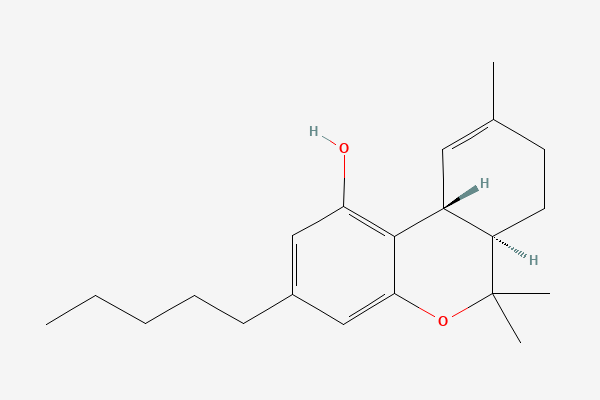
Delta-9-THC, PubChem CID 16078, summarized here from the dronabinol capsule label. Oral absorption is high, systemic availability is low, and the terminal half-life is reported as 25 to 36 hours.

3 sourcesContent date Oct 3, 2026CompareExplore connectionsRevision history
Delta-9-THC molecular structure
PubChem
01

Overview

PubChem titles this record Tetrahydrocannabinol. The clinical text is the dronabinol capsule label: dronabinol is delta-9-THC. Labeled uses in adults are anorexia associated with weight loss in AIDS, and nausea and vomiting from cancer chemotherapy after conventional antiemetics fail. Flower and other cannabis preparations are outside this label.

How it works

Labeled cannabinoid

The capsule label calls dronabinol a cannabinoid and identifies it with delta-9-THC. [1]

02

Doses & routes

Study doses and reference exposures, with route, formulation and duration.

Food timing and solubility labels describe the cited route or formulation. Solubility alone does not establish whether food changes absorption.

Oral · By mouth · 3 records

Fasted multiple-dose pharmacokinetics, 2.5 mg

Approved-label context

2.5 mg [1]

Empty stomachFat-soluble
Ingredient / form
Dronabinol · Capsule
Route
Oral
Frequency
Twice daily
Duration
Multiple-dose pharmacokinetic study
Population
34 healthy subjects, ages 20–45, fasted
Purpose
Labeled pharmacokinetic summary

Absorption context The label describes high lipid solubility; this pharmacokinetic context was studied in fasted subjects.

Mean Cmax 1.32 ng/mL (SD 0.62), median Tmax 1.00 hour (0.50–4.00), AUC0-12 2.88 ng·hr/mL (SD 1.57).

Fasted multiple-dose pharmacokinetics, 5 mg

Approved-label context

5 mg [1]

Empty stomachFat-soluble
Ingredient / form
Dronabinol · Capsule
Route
Oral
Frequency
Twice daily
Duration
Multiple-dose pharmacokinetic study
Population
34 healthy subjects, ages 20–45, fasted
Purpose
Labeled pharmacokinetic summary

Absorption context The label describes high lipid solubility; this pharmacokinetic context was studied in fasted subjects.

Mean Cmax 2.96 ng/mL (SD 1.81), median Tmax 2.50 hours (0.50–4.00), AUC0-12 6.16 ng·hr/mL (SD 1.85).

Fasted multiple-dose pharmacokinetics, 10 mg

Approved-label context

10 mg [1]

Empty stomachFat-soluble
Ingredient / form
Dronabinol · Capsule
Route
Oral
Frequency
Twice daily
Duration
Multiple-dose pharmacokinetic study
Population
34 healthy subjects, ages 20–45, fasted
Purpose
Labeled pharmacokinetic summary

Absorption context The label describes high lipid solubility; this pharmacokinetic context was studied in fasted subjects.

Mean Cmax 7.88 ng/mL (SD 4.54), median Tmax 1.50 hours (0.50–3.50), AUC0-12 15.2 ng·hr/mL (SD 5.52). The label notes a slight increase in dose proportionality for mean Cmax and AUC0-12 as dose increased.

03

Identification tests

These are source-linked identification contexts. Reagent results are presumptive and do not establish exact identity, purity, concentration, or safety.

GC-MS confirmation in biological samples

Instrumental confirmation
Target
Delta-9-THC in blood or urine
Expected result
A validated GC-MS method identifies delta-9-THC using selective chromatographic and mass-spectral criteria in the studied matrix.
Interpretation
Confirmatory laboratory analysis can identify and quantify delta-9-THC in the validated biological sample context.
Limitations
Requires a qualified laboratory and matrix-specific validation; it does not identify an unknown capsule or establish product purity by itself.
[3]
04

Pharmacokinetics

Absorption, metabolism and elimination depend on the analyte, route, formulation, physiology and other exposures.

Elimination half-life · Dronabinol (delta-9-THC)
Terminal about 25–36 hours

Timing explorer

Published timing evidence
The source reports timing terms but does not provide numeric elapsed intervals.
Peak
Parent drug and 11-hydroxy-delta-9-THC peak at about 0.5 to 4 hours after oral dosing. In a multiple-dose fasted study, median Tmax was 1.00 hour at 2.5 mg, 2.50 hours at 5 mg, and 1.50 hours at 10 mg.

Not established as a numeric timeline. Plasma timing and felt effects are distinct measurements. Source

Modeled elimination

The elimination model describes the named analyte after absorption and distribution. It does not establish felt-effect timing.

Oral · Capsule · reported-range

Not modeled

Elimination model

An elimination model is not established for this observation.

Source-bound record

This observation provides context about the measured record, but it does not support a first-order elimination curve.

Measured analyte
Dronabinol (delta-9-THC)
Route
Oral
Formulation
Capsule
Population
Pharmacokinetic descriptions in the prescribing label

Source context

Terminal half-life 25 to 36 hours. The initial half-life of about 4 hours is not an elimination estimate. Clearance averages about 0.2 L/kg-hr and is described as highly variable.
Read source context
Review the supporting record and source details.

The label describes a terminal (beta) half-life of 25 to 36 hours and an initial (alpha) half-life of about 4 hours. Only the terminal range is stored, and it is not modeled as a single value. [1]

Sourced elimination observations

Dronabinol (delta-9-THC)

Reported range

25–36 hours [1]

Route / formulation
Oral · Capsule
Population
Pharmacokinetic descriptions in the prescribing label

Terminal half-life 25 to 36 hours. The initial half-life of about 4 hours is not an elimination estimate. Clearance averages about 0.2 L/kg-hr and is described as highly variable.

Bioavailability
Almost completely absorbed (90 to 95%) after single oral doses. Because of first-pass hepatic metabolism and high lipid solubility, 10 to 20% of the administered dose reaches the systemic circulation. [1]
Metabolism / metabolites
Extensive first-pass hepatic metabolism, primarily by hydroxylation, yielding active and inactive metabolites. A high-fat, high-calorie meal (59 grams of fat, about 950 calories) delayed mean Tmax by 4 hours and increased AUCinf 2.9-fold. Cmax was not significantly changed. [1]

Factors that change the estimate

Diminished CYP2C9 function

Possibly higher exposure

Published data cited by the label indicate a potentially 2- to 3-fold higher dronabinol exposure in people with genetic variants associated with diminished CYP2C9 function. That statement is about exposure, not a revision of the 25–36 hour terminal range. [1]

Related observation
05

Safety & uncertainty

Adverse effects and interactions reported in the cited studies.

Warning

Hazardous activities and other depressants

The label says dronabinol can impair abilities needed for driving or operating machinery. Concomitant drugs that cause dizziness, confusion, sedation, or somnolence, including CNS depressants, may increase that effect. [1]

Interactions in cited sources

Explore a pair of substances
Ethanol

Ethanol is one example in the label's list of CNS depressants that may increase dizziness, confusion, sedation, or somnolence. Other named examples include barbiturates, benzodiazepines, lithium, opioids, buspirone, scopolamine, antihistamines, tricyclic antidepressants, other anticholinergic agents, and muscle relaxants. Formal drug-interaction studies have not been conducted. Published data cited by the label showed a 4-hour increase in pentobarbital elimination half-life when pentobarbital was dosed with dronabinol. [1]

06

Research & sources

3

Original publications, findings and available funding disclosures.

Reports elsewhere

This link leaves BHWiki for an outside experience index. It is not a finding, a dose, or a source for the claims above. The report text is not stored here.

07

Connected claims

Explore the participants, roles and sources behind each relationship.

class-identityAuthored relationship

The dronabinol capsule label identifies that product as a cannabinoid.

Adult capsule indications for AIDS-related anorexia and chemotherapy nausea after other antiemetics fail

Limitation The sentence applies to the labeled capsule. It does not review other cannabinoid analogues or cannabis flower.

Explore the relationship graph
08

Publication history

Content updated Oct 3, 2026.