 Wikipedia
Visuospatial memory
IncreasedFludrocortisone improved Rey/Taylor complex-figure visuospatial memory versus placebo across age groups (treatment effect F=5.0, p=0.03). [1]
Human research
The substance library
Fludrocortisone activates mineralocorticoid receptors. The linked research explores their role in stress responses and memory.
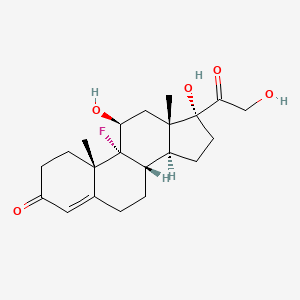
The cited study tests mineralocorticoid-receptor (MR) stimulation with fludrocortisone. It measured verbal, visuospatial, and working memory after fludrocortisone or placebo at least three days apart. The abstract reports no pharmacokinetic measurements or safety outcomes, so those fields remain unpopulated.
Fludrocortisone is an MR agonist. The study frames memory effects within glucocorticoid and mineralocorticoid receptor activity in the brain and reports better visuospatial and short-term memory after MR stimulation. [1]
What the research measured, for whom, and under which exposure. Findings remain attached to the study’s task or clinical endpoint.
Fludrocortisone improved Rey/Taylor complex-figure visuospatial memory versus placebo across age groups (treatment effect F=5.0, p=0.03). [1]
Digit-span forward performance was better after fludrocortisone than placebo across groups (treatment effect F=4.2, p=0.05); digit-span backward showed the expected age-group difference but not a reported treatment effect. [1]
Study doses and reference exposures, with route, formulation and duration.
Other routes · Other or unspecified · 1 record
Absorption, metabolism and elimination depend on the analyte, route, formulation, physiology and other exposures.
The linked memory trial reports no pharmacokinetic sampling or elimination estimate. [1]
Adverse effects and interactions reported in the cited studies.
PMID 25442112 tested one 0.4 mg dose in healthy adults and does not establish long-term cognitive benefit, pharmacokinetics, adverse-event rates, or suitability for self-directed use. [1]
The research-linked 2017 dissertation has no PubMed abstract in this corpus pass; its spatial-learning findings remain unreviewed. [2]
Original publications, findings and available funding disclosures.
Explore the participants, roles and sources behind each relationship.
Randomized double-blind within-subject crossover; conditions were at least three days apart.
Limitation Single acute study; no long-term efficacy or safety inference.
Content updated Nov 1, 2026.