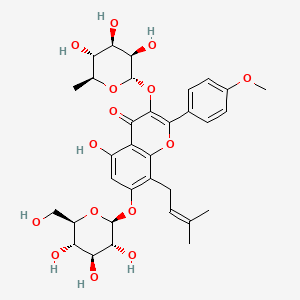
Icariin is a flavonoid found in Epimedium plants. Laboratory studies explore its effects on brain function and memory.
How it works
Source-specific finding from PMID 26364923
Chronic cerebral hypoperfusion is considered to be a pivotal contributing factor of cognitive impairments that occur in vascular dementia and Alzheimer's disease, and ideal drug treatment for these diseases is unavailable. Hence, this study was designed to investigate the protective effects of icariin, a major constituent of flavonoids from the Chinese medicinal herb Epimedium brevicornum, on cognitive impairments and neuronal morphological damage induced by permanent occlusion of bilateral common carotid arteries (BCCAO) in rats, and further explore the potential mechanisms. [2]
Source-specific finding from PMID 16380159
The behavioral, neurochemical and neuroendocrine effects of icariin isolated from Epimedium brevicornum were investigated in behavioral despair models of KunMing strain of male mice. Icariin was found to significantly shorten immobility time in the forced swimming test (FST) after orally administration for 21 consecutive days. [5]
Source-specific finding from PMID 26145038
A major goal of aging research now is to find pharmacological manipulations in healthspan extension. Icariin is a flavonol isolated from medicinal herbal tonics. [6]
02
Subjective effects
Reported experiences are kept separate from measured outcomes and remain tied to their cited context.
03
Measured outcomes
What the research measured, for whom, and under which exposure. Findings remain attached to the study’s task or clinical endpoint.
RESULTS: We observed a significant decrease in the HAMD (p = 0.012, d = 0.8), QIDS (p = 0.017, d = 0.7), and HAMA (p = 0.005, d = 1.4) scores. Heavy drinking days (p = 0.034, d = 1.1) and standard drinks (p = 0.038, d = 0.8) also decreased significantly. Icariin was well tolerated and no participants withdrew due to side-effects. CONCLUSION: Results from this uncontrolled study suggest icariin may decrease depressive symptoms and reduce alcohol consumption in persons with bipolar disorder and alcohol use. Improvement in mood and alcohol use was similar to that observed in an open-label trial of naltrexone in this population. Controlled trials, but at this point not routine clinical use, of [1]
Populationassessed using the Hamilton Rating Scale for Depression (HAMD), Quick Inventory of Depressive Symptomatology-Self Report (QIDS-SR), Hamilton Rating Scale for Anxiety (HAMA), and Young Mania Rating Scale (YMRS)ExposureRESULTS: We observed a significant decrease in the HAMD (p = 0.012, d = 0.8), QIDS (p = 0.017, d = 0.7), and HAMA (p = 0.005, d = 1.4) scores. Heavy drinking days (p = 0.034, d = 1.1) and standard drinks (p = 0.038, d = 0.8) also decreased significantly. Icariin was well tolerated and no participants withdrew due to side-effects. CONCLUSION: Results from this uncontrolled study suggest icariin may decrease depressive symptoms and reduce alcohol consumption in persons with bipolar disorder and alcohol use. Improvement in mood and alcohol use was similar to that observed in an open-label trial of naltrexone in this population. Controlled trials, but at this point not routine clinical use, of MeasureNot assessed
Chronic cerebral hypoperfusion is considered to be a pivotal contributing factor of cognitive impairments that occur in vascular dementia and Alzheimer's disease, and ideal drug treatment for these diseases is unavailable. Hence, this study was designed to investigate the protective effects of icariin, a major constituent of flavonoids from the Chinese medicinal herb Epimedium brevicornum, on cognitive impairments and neuronal morphological damage induced by permanent occlusion of bilateral common carotid arteries (BCCAO) in rats, and further explore the potential mechanisms. [2]
PopulationHence, this study was designed to investigate the protective effects of icariin, a major constituent of flavonoids from the Chinese medicinal herb Epimedium brevicornum, on cognitive impairments and neuronal morphological damage induced by permanent occlusion of bilateral common carotid arteries (BCCAO) in rats, and further explore the potential mechanisms.ExposureChronic cerebral hypoperfusion is considered to be a pivotal contributing factor of cognitive impairments that occur in vascular dementia and Alzheimer's disease, and ideal drug treatment for these diseases is unavailable. Hence, this study was designed to investigate the protective effects of icariin, a major constituent of flavonoids from the Chinese medicinal herb Epimedium brevicornum, on cognitive impairments and neuronal morphological damage induced by permanent occlusion of bilateral common carotid arteries (BCCAO) in rats, and further explore the potential mechanisms.MeasureNot assessed
Chronic mild stress (CMS) is suggested to produce abnormalities in the hypothalamic-pituitary-adrenal (HPA) axis and hypothalamus-pituitary-thyroid (HPT) axis. Therefore, compound that attenuates the neuroendocrinological alterations may have potential as antidepressant. [3]
PopulationThe behavioral and neuroendocrinological effects of icariin, a major constituent of flavonoids isolated from Epimedium brevicornum, were investigated in the CMS model of depression in male Wistar rats.ExposureChronic mild stress (CMS) is suggested to produce abnormalities in the hypothalamic-pituitary-adrenal (HPA) axis and hypothalamus-pituitary-thyroid (HPT) axis. Therefore, compound that attenuates the neuroendocrinological alterations may have potential as antidepressant.MeasureNot assessed
Icariin is one of the major active flavonoids constituents of Epimedium brevicornum MAXIM (Berberidaceae). Icariin and E. brevicornum have a wide range of pharmacological activities. [4]
PopulationIn the present study, the aim was to determine whether icariin possesses an antidepressant-like activity, and to explore the effects of icariin on the HPA axis and cytokine levels in chronic mild stress (CMS) model of depression in Sprague-Dawley rats.ExposureIcariin is one of the major active flavonoids constituents of Epimedium brevicornum MAXIM (Berberidaceae). Icariin and E. brevicornum have a wide range of pharmacological activities.MeasureNot assessed
Limited research
04
Doses & routes
Study doses and reference exposures, with route, formulation and duration.
Other routes · Other or unspecified · 1 record
05
Pharmacokinetics
Absorption, metabolism and elimination depend on the analyte, route, formulation, physiology and other exposures.
No validated elimination observation was imported in this corpus pass. [1]
06
Safety & uncertainty
Adverse effects and interactions reported in the cited studies.
Warning
Source-specific finding from PMID 26809351
RESULTS: We observed a significant decrease in the HAMD (p = 0.012, d = 0.8), QIDS (p = 0.017, d = 0.7), and HAMA (p = 0.005, d = 1.4) scores. Heavy drinking days (p = 0.034, d = 1.1) and standard drinks (p = 0.038, d = 0.8) also decreased significantly. Icariin was well tolerated and no participants withdrew due to side-effects. CONCLUSION: Results from this uncontrolled study suggest icariin may decrease depressive symptoms and reduce alcohol consumption in persons with bipolar disorder and alcohol use. Improvement in mood and alcohol use was similar to that observed in an open-label trial of naltrexone in this population. Controlled trials, but at this point not routine clinical use, of [1]
Monitor
Source-specific finding from PMID 17142971
Icariin is one of the major active flavonoids constituents of Epimedium brevicornum MAXIM (Berberidaceae). Icariin and E. brevicornum have a wide range of pharmacological activities. [4]
Context
Source-specific finding from PMID 26145038
A major goal of aging research now is to find pharmacological manipulations in healthspan extension. Icariin is a flavonol isolated from medicinal herbal tonics. [6]
Original publications, findings and available funding disclosures.
08
Connected claims
Explore the participants, roles and sources behind each relationship.
associated-withAuthored relationship
PMID 26809351 reports: RESULTS: We observed a significant decrease in the HAMD (p = 0.012, d = 0.8), QIDS (p = 0.017, d = 0.7), and HAMA (p = 0.005, d = 1.4) scores. Heavy drinking days (p = 0.034, d = 1.1) and standard drinks (p = 0.038, d = 0.8) also decreased significantly. Icariin was well tolerated and no participants withdrew due to side-effects. CONCLUSION: Results from this uncontrolled study suggest icariin may decrease depressive symptoms and reduce alcohol consumption in persons with bipolar disorder and alcohol use. Improvement in mood and alcohol use was similar to that observed in an open-label trial of naltrexone in this population. Controlled trials, but at this point not routine clinical use, of
Publication abstract; direction and population are retained on the linked observation.
Limitation Automated corpus import from an abstract; this record is not an independent meta-analysis.
associated-withAuthored relationship
PMID 26364923 reports: Chronic cerebral hypoperfusion is considered to be a pivotal contributing factor of cognitive impairments that occur in vascular dementia and Alzheimer's disease, and ideal drug treatment for these diseases is unavailable. Hence, this study was designed to investigate the protective effects of icariin, a major constituent of flavonoids from the Chinese medicinal herb Epimedium brevicornum, on cognitive impairments and neuronal morphological damage induced by permanent occlusion of bilateral common carotid arteries (BCCAO) in rats, and further explore the potential mechanisms.
Publication abstract; direction and population are retained on the linked observation.
Limitation Automated corpus import from an abstract; this record is not an independent meta-analysis.
associated-withAuthored relationship
PMID 17509675 reports: Chronic mild stress (CMS) is suggested to produce abnormalities in the hypothalamic-pituitary-adrenal (HPA) axis and hypothalamus-pituitary-thyroid (HPT) axis. Therefore, compound that attenuates the neuroendocrinological alterations may have potential as antidepressant.
Publication abstract; direction and population are retained on the linked observation.
Limitation Automated corpus import from an abstract; this record is not an independent meta-analysis.
associated-withAuthored relationship
PMID 17142971 reports: Icariin is one of the major active flavonoids constituents of Epimedium brevicornum MAXIM (Berberidaceae). Icariin and E. brevicornum have a wide range of pharmacological activities.
Publication abstract; direction and population are retained on the linked observation.
Limitation Automated corpus import from an abstract; this record is not an independent meta-analysis.
associated-withAuthored relationship
PMID 16380159 reports: The behavioral, neurochemical and neuroendocrine effects of icariin isolated from Epimedium brevicornum were investigated in behavioral despair models of KunMing strain of male mice. Icariin was found to significantly shorten immobility time in the forced swimming test (FST) after orally administration for 21 consecutive days.
Publication abstract; direction and population are retained on the linked observation.
Limitation Automated corpus import from an abstract; this record is not an independent meta-analysis.
associated-withAuthored relationship
PMID 26145038 reports: A major goal of aging research now is to find pharmacological manipulations in healthspan extension. Icariin is a flavonol isolated from medicinal herbal tonics.
 Examine
 Wikipedia