The substance library

SulbutiamineResearch profile

Sulbutiamine is a synthetic derivative of thiamine. Research explores fatigue, brain function and memory.

3 sourcesContent date Nov 1, 2026CompareExplore connectionsRevision history
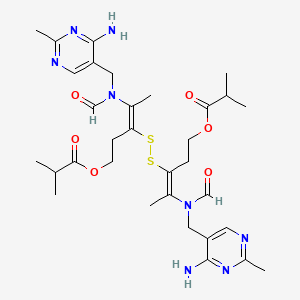
Sulbutiamine molecular structure
PubChem
01

Overview

Sulbutiamine is a synthetic derivative of thiamine. Research explores fatigue, brain function and memory.

How it works

Explicit mechanistic or disposition finding (PMID 10996447)

Chronic treatment of rats by sulbutiamine induced no change in density of N-methyl-D-aspartate (NMDA) and (+/-)-alpha-amino-3-hydroxy-5-methylisoxazole-4-propionic acid receptors in the cingular cortex, but a significant decrease of the kainate binding sites, as measured by quantitative autoradiography. [2]

Explicit mechanistic or disposition finding (PMID 4059305)

Thiamine deficiency in both man and animals is known to produce memory dysfunction and cognitive disorders which have been related to an impairment of cholinergic activity. [3]

02

Measured outcomes

What the research measured, for whom, and under which exposure. Findings remain attached to the study’s task or clinical endpoint.

Memory

Decreased

The present experiment was aimed at testing whether, inversely, chronic administration of large doses of sulbutiamine would have a facilitative effect on memory and would induce changes in central cholinergic activity. Accordingly mice received 300 mg/kg of sulbutiamine daily for 10 days. When compared to control subjects, sulbutiamine treated mice learned the task at the same rate in a single session but showed greatly improved performance when tested 24 hr after partial acquisition of the same task. [3]

PopulationThiamine deficiency in both man and animals is known to produce memory dysfunction and cognitive disorders which have been related to an impairment of cholinergic activity.ExposureAccordingly mice received 300 mg/kg of sulbutiamine daily for 10 days.MeasureNot assessed
Limited research
03

Doses & routes

Study doses and reference exposures, with route, formulation and duration.

Other routes · Other or unspecified · 1 record

PMID 4059305 study exposure: 300 mg/kg

Research exposure

300 mg/kg [3]

Ingredient / form
Sulbutiamine · Study formulation as stated in the abstract
Frequency
As stated in the abstract
Duration
Study duration as stated in the abstract
Population
Thiamine deficiency in both man and animals is known to produce memory dysfunction and cognitive disorders which have been related to an impairment of cholinergic activity.
Purpose
Research exposure; not a general-use recommendation

Accordingly mice received 300 mg/kg of sulbutiamine daily for 10 days

04

Pharmacokinetics

Absorption, metabolism and elimination depend on the analyte, route, formulation, physiology and other exposures.

No pharmacokinetic observation was supplied by this identity import. [1]

05

Research & sources

3

Original publications, findings and available funding disclosures.

06

Connected claims

Explore the participants, roles and sources behind each relationship.

associated-withAuthored relationship

The present experiment was aimed at testing whether, inversely, chronic administration of large doses of sulbutiamine would have a facilitative effect on memory and would induce changes in central cholinergic activity. Accordingly mice received 300 mg/kg of sulbutiamine daily for 10 days. When compared to control subjects, sulbutiamine treated mice learned the task at the same rate in a single session but showed greatly improved performance when tested 24 hr after partial acquisition of the same task.

Sulbutiamineintervention or exposure
Memory performancereported endpoint

PMID 4059305 abstract result/conclusion; direction and population are retained on the linked observation.

Limitation Single publication; the abstract does not establish general efficacy or safety.

Explore the relationship graph
07

Publication history

Content updated Nov 1, 2026.

Keep exploring

View graph