 Wikipedia
 Examine
Episodic Memory
IncreasedAfter 3 months, the carnosine/anserine group had better verbal episodic-memory performance than placebo. [4]
Human research
The substance library
Carnosine is a dipeptide made from beta-alanine and histidine. Research explores its effects on cellular processes and cognition.
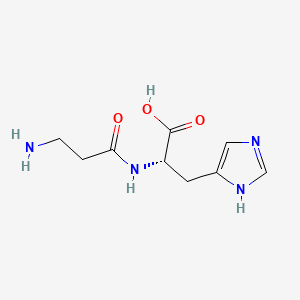
Small randomized studies in older adults suggest that carnosine/anserine formulas may preserve verbal episodic memory, but evidence is limited to short, small trials.
The 500 mg twice-daily formula improved verbal episodic memory and changed default-mode and frontoparietal resting-state connectivity versus placebo. [4]
The 1 g/day formula was associated with lower CCL-2/IL-8 secretion and less age-related posterior-cingulate perfusion decline. [3]
What the research measured, for whom, and under which exposure. Findings remain attached to the study’s task or clinical endpoint.
After 3 months, the carnosine/anserine group had better verbal episodic-memory performance than placebo. [4]
Delayed-recall verbal memory was preserved versus placebo after 3 months of 1 g/day anserine/carnosine; inflammatory cytokines and posterior-cingulate perfusion also changed. [3]
Study doses and reference exposures, with route, formulation and duration.
Oral · By mouth · 2 records
Absorption, metabolism and elimination depend on the analyte, route, formulation, physiology and other exposures.
No pharmacokinetic observation was supplied by this identity import. [1]
Adverse effects and interactions reported in the cited studies.
The linked trials studied mixed anserine/carnosine formulas, not isolated carnosine; generalization to other products is uncertain. [4]
Original publications, findings and available funding disclosures.
Explore the participants, roles and sources behind each relationship.
Double-blind placebo-controlled fMRI study; n=31.
Limitation Mixed formula and small sample.
Double-blind randomized trial with 39 completers.
Limitation Short duration and mixed formula.
Content updated Oct 27, 2026.