Hippocampal cornu ammonis activity
IncreasedDCS increased blood-oxygen-level-dependent activity in the probabilistically defined hippocampal cornu ammonis region during declarative learning. [1]
Human research
The substance library
D-cycloserine modulates NMDA-receptor signalling. Research explores learning, memory and the updating of learned responses.
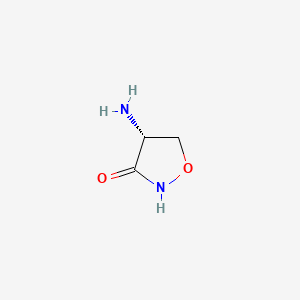
A randomized fMRI study in 40 healthy volunteers used a single 250 mg oral dose and found improved declarative learning with increased activity in hippocampal cornu ammonis. A second randomized study administered 500 mg after fear conditioning to healthy women; at 72 hours, DCS enhanced conditioned fear responses and associated hippocampal/medial-prefrontal responses. The linked review (PMID 19520359; PMC2752328) argues that DCS may preferentially facilitate lower-order automatic extinction learning during exposure-based therapy, while lab-based human extinction studies often show no effect.
DCS acts as a partial agonist at the NMDA receptor glycine-binding site, a mechanism proposed to facilitate hippocampal and amygdala-dependent learning. [1]
The full-text fear-conditioning study interprets enhanced 72-hour conditioned responses and hippocampal/medial-prefrontal activity as evidence that NMDA receptors regulate human fear-memory consolidation. [2]
The linked review proposes that DCS may preferentially facilitate lower-level automatic learning during exposure-based therapy, whereas higher-order cognitive laboratory extinction may show little or no benefit. [3]
Reported experiences are kept separate from measured outcomes and remain tied to their cited context.
What the research measured, for whom, and under which exposure. Findings remain attached to the study’s task or clinical endpoint.
DCS increased blood-oxygen-level-dependent activity in the probabilistically defined hippocampal cornu ammonis region during declarative learning. [1]
Relative to placebo, DCS enhanced skin-conductance responses to the conditioned stimulus at the 72-hour memory test, indicating stronger fear-memory expression under this paradigm. [2]
Study doses and reference exposures, with route, formulation and duration.
Oral · By mouth · 2 records
Absorption, metabolism and elimination depend on the analyte, route, formulation, physiology and other exposures.
The elimination model describes the named analyte after absorption and distribution. It does not establish felt-effect timing.
Oral · DCS tablets · not-established
Elimination model
This observation provides context about the measured record, but it does not support a first-order elimination curve.
Source context
PMC full text states DCS has a plasma half-life of approximately 10-12 hours; this was used to keep the 72-hour test drug-free.Read source context
No validated elimination observation was imported in this corpus pass. [1]
Adverse effects and interactions reported in the cited studies.
In the full-text 500 mg study, one participant withdrew three days after ingestion of DCS complaining of headaches. [2]
The observed effects were measured in declarative-learning and fear-conditioning tasks in small healthy samples; they do not establish broad cognitive enhancement or clinical efficacy. [1]
The full-text study excluded medication use, kidney impairment, heart conditions, porphyria and antibiotic allergy; this is study eligibility context, not a complete safety label. [2]
The PMC review notes contradictory human laboratory extinction results and argues that effects may depend on lower-order fear processes; exposure-therapy translation remains context-specific. [3]
Original publications, findings and available funding disclosures.
Explore the participants, roles and sources behind each relationship.
Randomized fMRI study of 40 healthy volunteers.
Limitation Single acute laboratory study; no clinical endpoint.
Randomized double-blind study; 500 mg DCS after conditioning.
Limitation Fear-conditioning paradigm and small sample; stronger fear response is not a general benefit.
Content updated Nov 1, 2026.