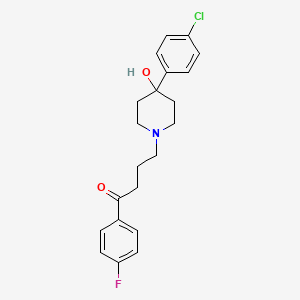
Haloperidol blocks dopamine receptors. Research explores the role of dopamine in learning, attention and memory.
How it works
Source-specific finding from PMID 16768602
The authors test a neurocomputational model of dopamine function in cognition by administering to healthy participants low doses of D2 agents cabergoline and haloperidol. The model suggests that DA dynamically modulates the balance of Go and No-Go basal ganglia pathways during cognitive learning and performance. [2]
02
Measured outcomes
What the research measured, for whom, and under which exposure. Findings remain attached to the study’s task or clinical endpoint.
The authors test a neurocomputational model of dopamine function in cognition by administering to healthy participants low doses of D2 agents cabergoline and haloperidol. The model suggests that DA dynamically modulates the balance of Go and No-Go basal ganglia pathways during cognitive learning and performance. [2]
PopulationThe authors test a neurocomputational model of dopamine function in cognition by administering to healthy participants low doses of D2 agents cabergoline and haloperidol.ExposureThe authors test a neurocomputational model of dopamine function in cognition by administering to healthy participants low doses of D2 agents cabergoline and haloperidol. The model suggests that DA dynamically modulates the balance of Go and No-Go basal ganglia pathways during cognitive learning and performance.MeasureNot assessed
Cognitive dysfunction in patients with schizophrenia is a strong correlate of poor outcome than any other symptom domain. To have greater knowledge about the effects of antipsychotics on cognitive function, subjects of this study were healthy volunteers who had no confounding variables typically found in patients with schizophrenia. [3]
Populationthis study were healthy volunteers who had no confounding variables typically found in patients with schizophreniaExposureCognitive dysfunction in patients with schizophrenia is a strong correlate of poor outcome than any other symptom domain. To have greater knowledge about the effects of antipsychotics on cognitive function, subjects of this study were healthy volunteers who had no confounding variables typically found in patients with schizophrenia.MeasureNot assessed
Human research
03
Doses & routes
Study doses and reference exposures, with route, formulation and duration.
Other routes · Other or unspecified · 1 record
04
Pharmacokinetics
Absorption, metabolism and elimination depend on the analyte, route, formulation, physiology and other exposures.
No pharmacokinetic observation was supplied by this identity import. [1]
05
Safety & uncertainty
Adverse effects and interactions reported in the cited studies.
Warning
Source-specific finding from PMID 16768602
The authors test a neurocomputational model of dopamine function in cognition by administering to healthy participants low doses of D2 agents cabergoline and haloperidol. The model suggests that DA dynamically modulates the balance of Go and No-Go basal ganglia pathways during cognitive learning and performance. [2]
Original publications, findings and available funding disclosures.
07
Connected claims
Explore the participants, roles and sources behind each relationship.
associated-withAuthored relationship
PMID 16768602 reports: The authors test a neurocomputational model of dopamine function in cognition by administering to healthy participants low doses of D2 agents cabergoline and haloperidol. The model suggests that DA dynamically modulates the balance of Go and No-Go basal ganglia pathways during cognitive learning and performance.
Publication abstract; direction and population are retained on the linked observation.
Limitation Automated corpus import from an abstract; this record is not an independent meta-analysis.
associated-withAuthored relationship
PMID 23131890 reports: Cognitive dysfunction in patients with schizophrenia is a strong correlate of poor outcome than any other symptom domain. To have greater knowledge about the effects of antipsychotics on cognitive function, subjects of this study were healthy volunteers who had no confounding variables typically found in patients with schizophrenia.