The substance library

MeldoniumCarnitine-modulating cardiovascular drug

Also known as: Mildronate · Mildronāts · mildonium · мельдоний · Милдронат · MET-88 · THP

Meldonium is a cardiovascular drug marketed as Mildronate. Two controlled trials found longer bicycle exercise times with adjunctive meldonium in adults with stable angina. Evidence for better athletic performance is limited. (4, 5, 13)
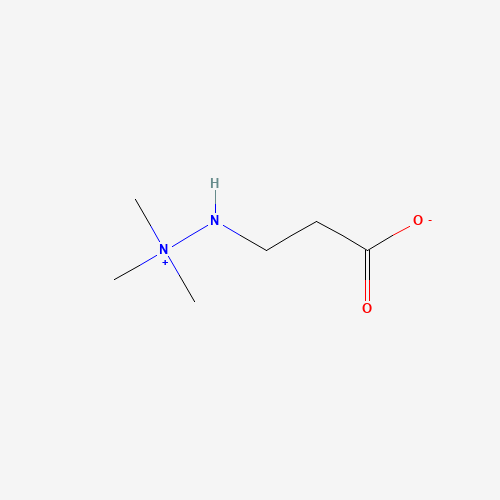
21 sourcesContent date Nov 18, 2026CompareExplore connectionsRevision history
Meldonium molecular structure
PubChem
01

Overview

The molecular record describes anhydrous meldonium. Each capsule in the Irish Mildronate 500 mg label contains 500 mg of meldonium dihydrate, equivalent to 401.14 mg of meldonium. Lithuania lists a separate intravenous solution containing 100 mg/mL of meldonium dihydrate. (1, 2, 3)

How it works

Inhibition of carnitine synthesis

Meldonium inhibited γ-butyrobetaine hydroxylase (BBOX1) in biochemical assays. BBOX1 catalyzes the last step in endogenous L-carnitine synthesis. [18]

Competition for carnitine transport

Transport assays found competition with L-carnitine at OCTN2. The mouse experiments investigated how this pathway affects tissue retention and excretion. [20]

02

Subjective effects

Reported experiences are kept separate from measured outcomes and remain tied to their cited context.

Variable
Subjective reports

Placebo participants reported the greatest number of positive subjective changes, including mood, sleep and general well-being. The paper gives no comparable count for meldonium. [13]

Population
Competitive ski-sport athletes
Exposure context
Mildronate over the 15-day study period, dose and route unclear
03

Measured outcomes

What the research measured, for whom, and under which exposure. Findings remain attached to the study’s task or clinical endpoint.

Mean change from baseline in the 100 mg/day arm versus a −7.10-second change in the placebo arm. No statistically significant difference from placebo. [4]

PopulationAdults with stable angina and exercise-limiting myocardial ischemiaExposure100 mg/day as Mildronate, divided twice daily on standard therapyMeasureBicycle ergometry, change from baseline
Human research

Mean change from baseline in the 300 mg/day arm versus a −7.10-second change in the placebo arm. No statistically significant difference from placebo. [4]

PopulationAdults with stable angina and exercise-limiting myocardial ischemiaExposure300 mg/day as Mildronate, divided twice daily on standard therapyMeasureBicycle ergometry, change from baseline
Human research

Mean change from baseline in the 1000 mg/day arm versus a −7.10-second change in the placebo arm. The between-group comparison favored Mildronate (p = 0.002). [4]

PopulationAdults with stable angina and exercise-limiting myocardial ischemiaExposure1000 mg/day as Mildronate, divided twice daily on standard therapyMeasureBicycle ergometry, change from baseline
Human research

Mean change from baseline in the 3000 mg/day arm versus a −7.10-second change in the placebo arm. The report describes a significant comparison with placebo. The observed improvement was smaller than in the 1000 mg/day arm. [4]

PopulationAdults with stable angina and exercise-limiting myocardial ischemiaExposure3000 mg/day as Mildronate, divided twice daily on standard therapyMeasureBicycle ergometry, change from baseline
Human research

At 1000 mg/day, workload change favored meldonium (p = 0.026). The other doses did not differ significantly from placebo. The secondary analyses were not adjusted for multiplicity. [4]

PopulationAdults with stable angina and exercise-limiting myocardial ischemiaExposure1000 mg/day as Mildronate on standard therapyMeasureBicycle ergometry, maximum load change from baseline
Human research

None of the doses differed significantly from placebo at week 12. [4]

PopulationAdults with stable angina and exercise-limiting myocardial ischemiaExposure100, 300, 1000 or 3000 mg/day as Mildronate on standard therapyMeasureTime to angina during bicycle ergometry
Human research

Change from baseline favored meldonium (p < 0.001). Table 2 lists 253 available month-12 observations in the 278-patient analysis population. [5]

PopulationAdults with CCS class II–III stable angina and exercise-limiting myocardial ischemiaExposure1000 mg/day as Mildronate on standard therapyMeasureBicycle ergometry, change from baseline
Human research

Change in maximum achieved load favored meldonium (p < 0.001). [5]

PopulationAdults with CCS class II–III stable angina and exercise-limiting myocardial ischemiaExposure1000 mg/day as Mildronate on standard therapyMeasureBicycle ergometry, maximum load change from baseline
Human research

The month-12 comparison favored meldonium (p = 0.01). This ECG threshold is a measured exercise endpoint. [5]

PopulationAdults with CCS class II–III stable angina and exercise-limiting myocardial ischemiaExposure1000 mg/day as Mildronate on standard therapyMeasureExercise ECG during bicycle ergometry
Human research

The raw month-12 mean time to chest pain was longer with meldonium (p = 0.044). [5]

PopulationAdults with CCS class II–III stable angina and exercise-limiting myocardial ischemiaExposure1000 mg/day as Mildronate on standard therapyMeasureTime to angina during bicycle ergometry
Human research

The reported thresholds did not differ statistically between groups. The comparison does not establish clinical equivalence. [7]

PopulationAdults with acute ischemic strokeExposureMildronate injection plus background aspirinMeasureModified Rankin Scale
Human research

The reported thresholds did not differ statistically between groups. The comparison does not establish clinical equivalence. [7]

PopulationAdults with acute ischemic strokeExposureMildronate injection plus background aspirinMeasureNational Institutes of Health Stroke Scale
Human research

The reported thresholds did not differ statistically between groups. The comparison does not establish clinical equivalence. [7]

PopulationAdults with acute ischemic strokeExposureMildronate injection plus background aspirinMeasureBarthel Index
Human research

Attack frequency fell more in the meldonium group during short inpatient follow-up. Background medication was adjusted in both groups. [9]

PopulationAdults aged 45–75 with class II–III heart failure, 3–4 weeks after myocardial infarctionExposure1000 mg/day IV as an add-onMeasureNot assessed
Human research

The study did not find a statistically significant difference in ejection fraction changes between groups. [9]

PopulationAdults aged 45–75 with class II–III heart failure, 3–4 weeks after myocardial infarctionExposure1000 mg/day IV as an add-onMeasureEchocardiography, Simpson method
Human research

Walking distance increased in both active arms. The abstract does not quantify an incremental meldonium effect over usual care. [10]

PopulationAdults more than 6 months after myocardial infarction with chronic heart failure and LVEF below 40%Exposure1000 mg/day meldonium dihydrate on background therapyMeasureSix-minute walk test
Human research

The investigators reported a significant LVEF increase only in the trimetazidine group. [10]

PopulationAdults more than 6 months after myocardial infarction with chronic heart failure and LVEF below 40%Exposure1000 mg/day meldonium dihydrate on background therapyMeasureDobutamine stress echocardiography
Human research

Walk distance increased at the end of treatment (paired comparison p = 0.021). There was no concurrent control group. [11]

PopulationAdults with pulmonary arterial hypertension and right ventricular failureExposure500 mg twice daily for 30 days on background treatmentMeasureSix-minute walk test
Human research

Thirty days after the end of treatment, the study found no significant difference from baseline. [11]

PopulationAdults with pulmonary arterial hypertension and right ventricular failureExposure500 mg twice daily for 30 days on background treatmentMeasureSix-minute walk test
Human research

The authors reported a lower dyspnea score at the end of treatment (p = 0.003) and at day 60 (p = 0.004). [11]

PopulationAdults with pulmonary arterial hypertension and right ventricular failureExposure500 mg twice daily for 30 days on background treatmentMeasureBorg dyspnea scale after six-minute walk
Human research

Treadmill duration changed little in either arm. The small nonrandomized comparison provides limited evidence about performance effects. [13]

PopulationCompetitive ski-sport athletesExposureMildronate over the 15-day study period, dose and route unclearMeasureRoller-ski treadmill ergospirometry
Human research

The groups already differed at baseline. VO₂max fell from a higher baseline in the meldonium group, with no clear evidence of a treatment advantage. [13]

PopulationCompetitive ski-sport athletesExposureMildronate over the 15-day study period, dose and route unclearMeasureRoller-ski treadmill ergospirometry
Human research

The SAN mood subscale favored placebo at day 15 in the small nonrandomized study (p < 0.05). [13]

PopulationCompetitive ski-sport athletesExposureMildronate over the 15-day study period, dose and route unclearMeasureSAN mood subscale
Human research

Plasma L-carnitine fell over four weeks. Higher meat intake was associated with a smaller decrease in this uncontrolled study. [21]

PopulationHealthy adults eating a nonvegetarian dietExposure500 mg twice daily for 4 weeksMeasurePlasma UPLC–MS/MS
Human research

The carnitine precursor increased in both sexes after four weeks. The trial had no parallel control group. [21]

PopulationHealthy adults eating a nonvegetarian dietExposure500 mg twice daily for 4 weeksMeasurePlasma UPLC–MS/MS
Human research
Study-result plots

12 of 25 findings in this selection lack structured estimates. Different measures, populations, instruments, comparators, or assessment times are shown separately.

MILSS I bicycle exercise time (100 mg/day)
Bicycle ergometry, change from baseline · mean · s

Adults with stable angina and exercise-limiting myocardial ischemia · Comparator: Placebo plus standard therapy · Assessment: Week 12

Study estimates and reported confidence intervals for MILSS I bicycle exercise time (100 mg/day). Linear horizontal axis.1234-6.64.9716.528.139.7

Each point is one reported estimate. Intervals are displayed only when recorded. No pooled estimate is calculated.

Study / substanceEstimateIntervalEvidence
1. Meldonium
milss-i
-2.12 sInterval not curated
2. Meldonium
milss-i
11.48 sInterval not curated
3. Meldonium
milss-i
35.18 sInterval not curated
4. Meldonium
milss-i
28.08 sInterval not curated
MILSS I maximum bicycle workload
Bicycle ergometry, maximum load change from baseline · mean · W

Adults with stable angina and exercise-limiting myocardial ischemia · Comparator: Placebo plus standard therapy · Assessment: Week 12

Study estimates and reported confidence intervals for MILSS I maximum bicycle workload. Linear horizontal axis.14.955.295.635.976.31

Each point is one reported estimate. Intervals are displayed only when recorded. No pooled estimate is calculated.

Study / substanceEstimateIntervalEvidence
1. Meldonium
milss-i
5.63 WInterval not curated
MILSS II bicycle exercise time
Bicycle ergometry, change from baseline · mean · s

Adults with CCS class II–III stable angina and exercise-limiting myocardial ischemia · Comparator: Placebo plus standard therapy · Assessment: Month 12

Study estimates and reported confidence intervals for MILSS II bicycle exercise time. Linear horizontal axis.148.451.755.158.461.7

Each point is one reported estimate. Intervals are displayed only when recorded. No pooled estimate is calculated.

Study / substanceEstimateIntervalEvidence
1. Meldonium
eudract-2004-001611-58
55.05 sInterval not curated
MILSS II maximum bicycle workload
Bicycle ergometry, maximum load change from baseline · mean · W

Adults with CCS class II–III stable angina and exercise-limiting myocardial ischemia · Comparator: Placebo plus standard therapy · Assessment: Month 12

Study estimates and reported confidence intervals for MILSS II maximum bicycle workload. Linear horizontal axis.16.857.317.788.258.71

Each point is one reported estimate. Intervals are displayed only when recorded. No pooled estimate is calculated.

Study / substanceEstimateIntervalEvidence
1. Meldonium
eudract-2004-001611-58
7.78 WInterval not curated
MILSS II time to 1 mm st-segment deviation
Exercise ECG during bicycle ergometry · mean · s

Adults with CCS class II–III stable angina and exercise-limiting myocardial ischemia · Comparator: Placebo plus standard therapy · Assessment: Month 12

Study estimates and reported confidence intervals for MILSS II time to 1 mm st-segment deviation. Linear horizontal axis.1426455484513542

Each point is one reported estimate. Intervals are displayed only when recorded. No pooled estimate is calculated.

Study / substanceEstimateIntervalEvidence
1. Meldonium
eudract-2004-001611-58
483.83 sInterval not curated
MILSS II time to exercise-induced angina
Time to angina during bicycle ergometry · mean · s

Adults with CCS class II–III stable angina and exercise-limiting myocardial ischemia · Comparator: Placebo plus standard therapy · Assessment: Month 12

Study estimates and reported confidence intervals for MILSS II time to exercise-induced angina. Linear horizontal axis.1432461491520549

Each point is one reported estimate. Intervals are displayed only when recorded. No pooled estimate is calculated.

Study / substanceEstimateIntervalEvidence
1. Meldonium
eudract-2004-001611-58
490.5 sInterval not curated
Six-minute walk distance in right ventricular failure
Six-minute walk test · mean · m

Adults with pulmonary arterial hypertension and right ventricular failure · Comparator: Within-participant baseline · Assessment: Day 30

Study estimates and reported confidence intervals for Six-minute walk distance in right ventricular failure. Linear horizontal axis.1351375399423447

Each point is one reported estimate. Intervals are displayed only when recorded. No pooled estimate is calculated.

Study / substanceEstimateIntervalEvidence
1. Meldonium
kigitovica-2025-rvf
398.9 mInterval not curated
Six-minute walk distance after treatment ended
Six-minute walk test · mean · m

Adults with pulmonary arterial hypertension and right ventricular failure · Comparator: Within-participant baseline · Assessment: Day 60

Study estimates and reported confidence intervals for Six-minute walk distance after treatment ended. Linear horizontal axis.1331354377399422

Each point is one reported estimate. Intervals are displayed only when recorded. No pooled estimate is calculated.

Study / substanceEstimateIntervalEvidence
1. Meldonium
kigitovica-2025-rvf
376.7 mInterval not curated
Post-walk breathlessness in right ventricular failure
Borg dyspnea scale after six-minute walk · mean · points

Adults with pulmonary arterial hypertension and right ventricular failure · Comparator: Within-participant baseline · Assessment: Day 30

Study estimates and reported confidence intervals for Post-walk breathlessness in right ventricular failure. Linear horizontal axis.12.993.23.43.63.81

Each point is one reported estimate. Intervals are displayed only when recorded. No pooled estimate is calculated.

Study / substanceEstimateIntervalEvidence
1. Meldonium
kigitovica-2025-rvf
3.4 pointsInterval not curated
Self-rated mood score in ski-sport athletes
SAN mood subscale · mean · points

Competitive ski-sport athletes · Comparator: Placebo · Assessment: Day 15

Study estimates and reported confidence intervals for Self-rated mood score in ski-sport athletes. Linear horizontal axis.15.085.425.776.126.46

Each point is one reported estimate. Intervals are displayed only when recorded. No pooled estimate is calculated.

Study / substanceEstimateIntervalEvidence
1. Meldonium
goloborodko-razinkin-2021
5.77 pointsInterval not curated
04

Doses & routes

Study doses and reference exposures, with route, formulation and duration.

Food timing and solubility labels describe the cited route or formulation. Solubility alone does not establish whether food changes absorption.

Oral · By mouth · 7 records

Ireland, oral product label

Approved-label context

500–1,000 mg/day [2]

Ingredient / form
Meldonium dihydrate · Mildronate 500 mg hard capsule
Route
Oral
Frequency
Daily, with the 1000 mg daily amount optionally divided into two doses
Duration
4–6 weeks
Population
Adults with mild chronic cardiac insufficiency
Purpose
Adjunctive treatment in the Irish label

Absorption context The label permits administration with food to reduce gastrointestinal symptoms.

Each capsule corresponds to 401.14 mg anhydrous meldonium.

MILSS I dose-ranging trial

Research exposure

100, 300, 1000 or 3000 mg/day, in four discrete arms [4]

Ingredient / form
Meldonium, as reported · Mildronate oral study product
Route
Oral
Frequency
Twice daily in equal divided doses
Duration
12 weeks
Population
Adults with stable angina and exercise-limiting ischemia
Purpose
Dose-ranging adjunct to background therapy

Separate study groups received 50, 150, 500 or 1500 mg per administration. The paper reports product doses without an anhydrous-equivalent conversion.

MILSS II stable angina trial

Research exposure

1,000 mg/day [5]

Ingredient / form
Meldonium, as reported · Mildronate 500 mg capsules
Route
Oral
Frequency
500 mg twice daily
Duration
12 months
Population
Adults with CCS class II–III stable angina and exercise-limiting ischemia
Purpose
Adjunct to background therapy versus placebo

Form verified in EudraCT 2004-001611-58. Study mass basis retained as reported.

Healthy volunteer oral pharmacokinetics

Research exposure

Single 250, 500, 1000, 1250 or 1500 mg, then 500 mg per administration in the repeat-dose cohort [14]

Ingredient / form
Meldonium, as reported · Mildronate capsules
Route
Oral
Frequency
Single exposure, followed by three times daily in the 500 mg cohort
Duration
13 days in the repeated-dose phase
Population
40 healthy Chinese volunteers in the single-dose study
Purpose
Plasma pharmacokinetics

Only the 500 mg group continued to repeat dosing.

Human carnitine biomarker study

Research exposure

500 mg per dose [21]

Ingredient / form
Meldonium dihydrate · Mildronate
Route
Oral
Frequency
Twice daily between meals
Duration
4 weeks
Population
17 healthy nonvegetarian adults
Purpose
Plasma and urinary carnitine measurements

Compared with the same participants at baseline.

Pulmonary arterial hypertension with right ventricular failure pilot

Research exposure

500 mg per dose [11]

Ingredient / form
Meldonium, as reported · 500 mg meldonium capsules supplied by Grindeks
Route
Oral
Frequency
Twice daily
Duration
30 days
Population
Adults with pulmonary arterial hypertension and right ventricular failure
Purpose
Before-and-after functional assessment

The study followed participants for a further 30 days after treatment.

Repeat-dose athlete excretion study

Research exposure

1000 or 2000 mg/day in separate cohorts [17]

Ingredient / form
Meldonium, as reported · Cardionate 250 mg capsules
Route
Oral
Frequency
Daily
Duration
3 weeks
Population
32 healthy trained volunteers
Purpose
Plasma and urine follow-up after repeat exposure

The Russian report gives cohort sizes of 14 and 18. The study did not test athletic enhancement.

05

Pharmacokinetics

Absorption, metabolism and elimination depend on the analyte, route, formulation, physiology and other exposures.

Elimination half-life
Depends on route and dosing history

Timing explorer

Published timing evidence
The source reports timing terms but does not provide numeric elapsed intervals.
Onset
Subjective onset was not established in the cited pharmacokinetic studies.
Peak
Oral peak plasma concentration increased with dose in healthy volunteers.
Duration
Repeated oral dosing led to plasma accumulation in the capsule study.

Not established as a numeric timeline. Plasma timing and felt effects are distinct measurements. Source

Modeled elimination

The elimination model describes the named analyte after absorption and distribution. It does not establish felt-effect timing.

Intravenous · Mildronate injection · study-mean

Not modeled

Elimination model

An elimination model is not established for this observation.

Source-bound record

This observation provides context about the measured record, but it does not support a first-order elimination curve.

Measured analyte
Meldonium in plasma
Route
Intravenous
Formulation
Mildronate injection
Population
Healthy Chinese volunteers

Source context

Reported half-life after a single 250 mg dose, measured by LC–MS/MS.
Read source context
Review the supporting record and source details.

Plasma estimates vary across single and repeated dosing. Extended urinary detection is a separate measurement. [14]

Sourced elimination observations

Meldonium in plasma

Study mean

5.56 hours [15]

Route / formulation
Intravenous · Mildronate injection
Population
Healthy Chinese volunteers

Reported half-life after a single 250 mg dose, measured by LC–MS/MS.

Meldonium in plasma

Study mean

6.46 hours [15]

Route / formulation
Intravenous · Mildronate injection
Population
Healthy Chinese volunteers

Reported half-life after a single 500 mg dose, measured by LC–MS/MS.

Meldonium in plasma

Study mean

6.55 hours [15]

Route / formulation
Intravenous · Mildronate injection
Population
Healthy Chinese volunteers

Reported half-life after a single 1000 mg dose, measured by LC–MS/MS.

Meldonium in plasma

Study mean

15.34 hours [15]

Route / formulation
Intravenous · Mildronate injection
Population
Healthy Chinese volunteers

The authors observed plasma accumulation after repeated IV meldonium at 500 mg twice daily.

Bioavailability
The single-dose oral study measured dose-dependent plasma exposure without an IV comparison. [14]
Metabolism / metabolites
The oral study measured the parent drug in plasma. [14]

Factors that change the estimate

Repeated intravenous exposure

Longer measured plasma half-life

In one study, mean half-life was 6.46 hours after a single 500 mg injection and 15.34 hours after repeated 500 mg injections twice daily. [15]

Related observation
06

Safety & uncertainty

Adverse effects and interactions reported in the cited studies.

Warning

Hypersensitivity and labeled adverse reactions

The Irish capsule label contraindicates use in people with hypersensitivity to the drug or its excipients. It lists allergic reactions, headache and gastrointestinal symptoms as common. Tachycardia and hypotension are listed as very rare. [2]

Monitor

Chronic kidney or liver disease

The Irish capsule label calls for caution and dose reduction in renal or hepatic disorders and notes limited evidence in these higher-risk groups. [2]

Context

Pregnancy, breastfeeding and children

The Irish label recommends avoiding use during pregnancy as a precaution and weighing breastfeeding against treatment because infant risk cannot be excluded. It advises against pediatric use due to limited safety and efficacy data. [2]

Interactions in cited sources

Explore a pair of substances

Glyceryl trinitrate (nitroglycerin)

The Irish capsule label reports possible potentiation of glyceryl trinitrate. The source does not quantify its frequency or magnitude. [2]

Context
Oral meldonium dihydrate capsule labeling lists this named drug.

Nifedipine

The Irish capsule label identifies nifedipine as an example of a cardiovascular medicine whose effects meldonium may intensify. [2]

Context
Oral meldonium dihydrate capsule labeling. An estimate from a dedicated interaction study was unavailable.

Beta-blockers and other blood-pressure-lowering agents

The Irish capsule label warns of possible potentiation of beta-blockers, other blood-pressure-lowering medicines and peripheral vasodilators. [2]

Context
The label identifies classes and provides no quantitative estimates for specific pairs.
07

Research & sources

21

Original publications, findings and available funding disclosures.

08

Connected claims

Explore the participants, roles and sources behind each relationship.

inhibitsAuthored relationship

Meldonium inhibits γ-butyrobetaine hydroxylase in biochemical assays.

Experimental enzyme inhibition

Limitation The assay does not estimate a clinical effect.

competes for transport byAuthored relationship

Meldonium competes with L-carnitine for OCTN2-mediated transport.

Transport assays and experimental animal work

Limitation The experimental studies do not quantify the importance of this pathway in patients.

Explore the relationship graph
10

Publication history

Content updated Nov 18, 2026.

Keep exploring

View graph