 Wikipedia
 Examine
Episodic Memory
VariableSignificant improvements in CFFT and CRT were found after pyritinol. [2]
Limited research
The substance library
Pyritinol is a compound derived from vitamin B6. Studies explore memory and cognitive performance.
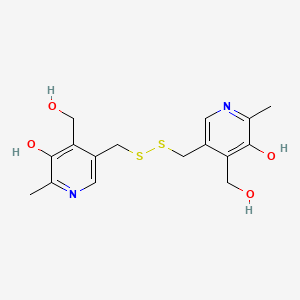
This page links PubMed evidence for pyritinol. Study populations, formulations and endpoints are retained per PMID; non-PubMed links remain provenance leads. Abstracts were retrieved for PMID(s) 2135070, 3066650, 9679051.
However, the exact mechanism of hypoglycemia linked with the presence of anti-insulin auto-antibodies is not yet clear as is the predisposition of a drug with a sulfydril group to induce such an auto-immune phenomenon. [5]
What the research measured, for whom, and under which exposure. Findings remain attached to the study’s task or clinical endpoint.
Significant improvements in CFFT and CRT were found after pyritinol. [2]
Study doses and reference exposures, with route, formulation and duration.
Other routes · Other or unspecified · 1 record
Absorption, metabolism and elimination depend on the analyte, route, formulation, physiology and other exposures.
No pharmacokinetic observation was supplied by this identity import. [1]
Original publications, findings and available funding disclosures.
Explore the participants, roles and sources behind each relationship.
Source-specific result from PMID 2135070; applies to the population and design described in that abstract.
Limitation Abstract result from PMID 2135070; this single study does not establish general efficacy or safety.
Source-specific result from PMID 9679051; applies to the population and design described in that abstract.
Limitation Abstract result from PMID 9679051; this single study does not establish general efficacy or safety.
Source-specific result from PMID 3066650; applies to the population and design described in that abstract.
Limitation Abstract result from PMID 3066650; this single study does not establish general efficacy or safety.
Content updated Oct 27, 2026.