The substance library

TolcaponeResearch compound

Tolcapone inhibits the enzyme COMT, which breaks down catecholamines. Studies explore effects on working memory and decision-making.

2 sourcesContent date Nov 1, 2026CompareExplore connectionsRevision history
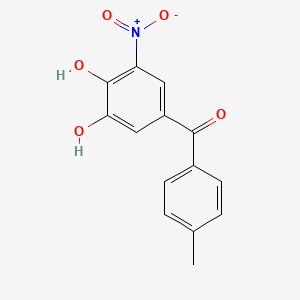
Tolcapone molecular structure
PubChem
01

Overview

Tolcapone inhibits the enzyme COMT, which breaks down catecholamines. Studies explore effects on working memory and decision-making.

How it works

Explicit mechanistic or disposition finding (PMID 17063156)

Prefrontal cortical dopamine (DA) regulates various executive cognitive functions, including attention and working memory. [1]

Explicit mechanistic or disposition finding (PMID 17909307)

The drug is generally well tolerated, with the most common adverse events being dopaminergic related. [2]

02

Measured outcomes

What the research measured, for whom, and under which exposure. Findings remain attached to the study’s task or clinical endpoint.

Efforts to enhance prefrontal-related cognition, which have focused on catecholaminergic stimulant drugs, have been unsatisfactory. We found significant drug effects on measures of executive function and verbal episodic memory and a significant drug by genotype interaction on the latter, such that individuals with val/val genotypes improved, whereas individuals with met/met genotypes worsened on tolcapone. fMRI revealed a significant tolcapone-induced improvement in the efficiency of information processing in prefrontal cortex during a working memory test. [1]

PopulationTo explore in a proof of concept study the effects of tolcapone, a CNS penetrant specific COMT inhibitor, we performed a randomized, double blind, placebo controlled, and crossover design of this drug in normal subjects stratified by COMT (val158met) genotype.ExposureRecently, the demonstration that a functional polymorphism in the catecholamine-O-methyltransferase (COMT) gene impacts prefrontal cognition raises the possibility of a novel pharmacological approach for the treatment of prefrontal lobe executive dysfunction.MeasurefMRI)
Human research
03

Pharmacokinetics

Absorption, metabolism and elimination depend on the analyte, route, formulation, physiology and other exposures.

No validated elimination observation was imported in this corpus pass. [1]

04

Safety & uncertainty

Adverse effects and interactions reported in the cited studies.

Warning

Safety or adverse-event finding (PMID 17063156)

Recently, the demonstration that a functional polymorphism in the catecholamine-O-methyltransferase (COMT) gene impacts prefrontal cognition raises the possibility of a novel pharmacological approach for the treatment of prefrontal lobe executive dysfunction. [1]

Monitor

Safety or adverse-event finding (PMID 17909307)

The drug is generally well tolerated, with the most common adverse events being dopaminergic related. [2]

Interactions in cited sources

Explore a pair of substances
05

Research & sources

2

Original publications, findings and available funding disclosures.

06

Connected claims

Explore the participants, roles and sources behind each relationship.

associated-withAuthored relationship

Efforts to enhance prefrontal-related cognition, which have focused on catecholaminergic stimulant drugs, have been unsatisfactory. We found significant drug effects on measures of executive function and verbal episodic memory and a significant drug by genotype interaction on the latter, such that individuals with val/val genotypes improved, whereas individuals with met/met genotypes worsened on tolcapone. fMRI revealed a significant tolcapone-induced improvement in the efficiency of information processing in prefrontal cortex during a working memory test.

Tolcaponeintervention or exposure
Episodic memoryreported endpoint

PMID 17063156 abstract result/conclusion; direction and population are retained on the linked observation.

Limitation Single publication; the abstract does not establish general efficacy or safety.

Explore the relationship graph
07

Publication history

Content updated Nov 1, 2026.

Keep exploring

View graph