Oral 2 g four times daily did not significantly improve memory storage, retrieval or digit span in nondemented adults over 60. [9]
Human research
The substance library
Also known as: Cholinium chloride · Choline hydrochloride · (2-Hydroxyethyl)trimethylammonium chloride
Choline chloride is a highly water-soluble choline salt used as a nutrient source. Human salt-specific evidence is strongest for short-term plasma choline delivery, prenatal supplementation within one small controlled-feeding cohort, and intravenous repletion in choline-deficient long-term parenteral-nutrition patients.
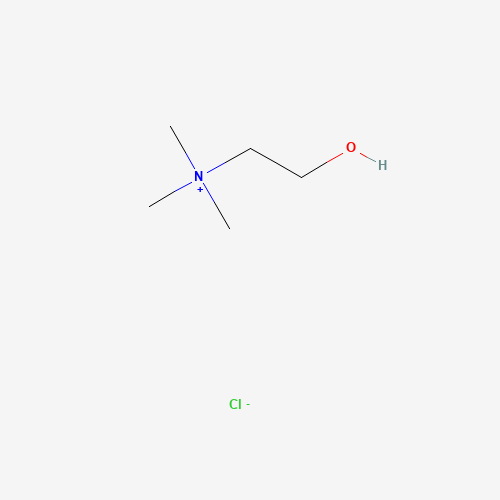
Choline chloride (CAS 67-48-1; PubChem CID 6209) is the chloride salt of choline, with about 74.6% choline-equivalent by mass in the pure anhydrous form. In one human crossover, 740 mg choline chloride supplied 550 mg choline. Commercial material can instead be aqueous or carried on solids, so product mass is not interchangeable with anhydrous salt mass.
Choline chloride is an ionic source of choline; a human oral crossover demonstrated a rapid rise in plasma choline after a dose explicitly quantified as 740 mg choline chloride providing 550 mg choline. [2]
After oral choline chloride, plasma betaine increased, consistent with oxidation of absorbed choline into the one-carbon metabolic pool. [2]
The oral crossover attributed post-dose TMAO formation from water-soluble choline sources to microbial trimethylamine generation followed by hepatic oxidation; the magnitude varied strongly among individuals. [2]
In severe long-term parenteral-nutrition deficiency, intravenous choline chloride restored plasma free choline and was accompanied by reversal of CT-estimated hepatic steatosis; the small clinical series does not by itself quantify the responsible biochemical step. [7]
What the research measured, for whom, and under which exposure. Findings remain attached to the study’s task or clinical endpoint.
Oral 2 g four times daily did not significantly improve memory storage, retrieval or digit span in nondemented adults over 60. [9]
In a small follow-up of the Cornell feeding cohort, infants born after the higher maternal choline intake had faster stimulus-guided saccade reaction times. This is prenatal developmental exposure, not acute adult cognition. [4]
A 20-child follow-up from the same cohort favored the higher maternal intake on sustained attention, but the small retained sample limits certainty and does not establish adult supplementation effects. [5]
Four long-term TPN patients with low plasma choline improved CT evidence of hepatic steatosis during intravenous repletion; one patient relapsed after choline-free PN resumed. [7]
Water-soluble choline chloride produced a transient plasma TMAO increase with substantial inter-individual variation; this biomarker does not establish cardiovascular harm. [2]
Study doses and reference exposures, with route, formulation and duration.
Oral · By mouth · 4 records
Absorption, metabolism and elimination depend on the analyte, route, formulation, physiology and other exposures.
The elimination model describes the named analyte after absorption and distribution. It does not establish felt-effect timing.
Oral · 740 mg choline chloride supplying 550 mg choline-equivalent · study-mean
Elimination model
This observation provides context about the measured record, but it does not support a first-order elimination curve.
Source context
Median free-choline Tmax was 2.25 hours, with median AUC0-6h 63.4 and AUC0-24h 235.2 micromol/L·h; concentrations returned near baseline by 24 hours. No validated terminal half-life was fitted.Read source context
Human intravenous choline-chloride pharmacokinetics were modeled as two-compartment with saturable central elimination, but the inspected report did not establish a single elimination half-life. [6]
Adverse effects and interactions reported in the cited studies.
Anhydrous choline chloride is about 74.6% choline-equivalent by mass; aqueous feed and carrier preparations have different active concentrations and are not human-product specifications. [1]
Oral water-soluble choline raises TMAO transiently, but available chloride studies did not test myocardial infarction, stroke, thrombosis or mortality. [2]
Favorable infant and age-seven attention signals come from a small late-pregnancy controlled-feeding cohort and cannot be transferred to acute adult nootropic claims. [5]
Intravenous choline chloride improved liver imaging in a four-person TPN-deficiency series; this uncontrolled evidence should not be extrapolated to choline-replete users. [7]
Original publications, findings and available funding disclosures.
Explore the participants, roles and sources behind each relationship.
Acute randomized crossover study in six healthy adult men; absolute oral bioavailability was not measured.
Limitation Small acute study; it does not establish chronic clinical benefit or a single absolute bioavailability value.
Uncontrolled six-week case series using 1-4 g/day choline chloride in parenteral nutrition.
Limitation Four-patient uncontrolled series in severe deficiency; it does not establish benefit in choline-sufficient populations.
NCT01127022 compared 480 versus 930 mg/day total maternal choline during the third trimester using choline chloride for the supplemental choline.
Limitation These are follow-ups from one small cohort, not independent replications, and the comparison tests total choline intake rather than salt chemistry.
Oral high-dose studies in elderly participants with mild memory impairment and young healthy subjects.
Limitation Old, small studies used very high doses and do not answer whether lower chronic doses affect modern cognitive endpoints.
Content updated Oct 10, 2026.