 Wikipedia
 Examine
Warning
No confirmed human cognitive benefit
The linked PubMed records do not provide an abstract supporting a human cognitive effect; the 1960 volunteer paper is retained as a metadata-only lead. [5]
The substance library
DMAE is a choline-related compound studied for its effects on brain function and cognition.
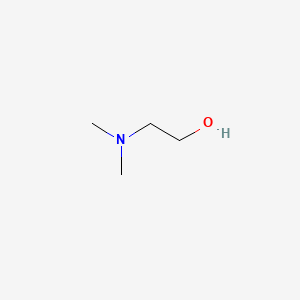
In rats, deanol inhibited blood-to-brain choline transport and raised blood choline (PMID 727735). A gas-chromatography study found no increase in whole-brain acetylcholine across 33.3–3000 mg/kg intraperitoneal doses in mice, no increase after 550 mg/kg in rat brain regions, and only a selective striatal increase after 900 mg/kg in mice that did not track tissue deanol (PMID 850128). The PubMed record for the 1960 volunteer stimulant study has no abstract (PMID 14425373), so no human outcome is asserted.
Deanol competes with choline for blood-to-brain carrier uptake and raises blood choline, so its effects on brain choline/acetylcholine cannot be assumed to reflect precursor conversion. [3]
A gas-chromatographic evaluation did not confirm deanol as an immediate precursor of brain acetylcholine; the only increase was a non-correlated selective striatal signal at a massive mouse dose. [4]
Reported experiences are kept separate from measured outcomes and remain tied to their cited context.
Study doses and reference exposures, with route, formulation and duration.
Other routes · Other or unspecified · 2 records
Absorption, metabolism and elimination depend on the analyte, route, formulation, physiology and other exposures.
No pharmacokinetic observation was supplied by this identity import. [1]
Adverse effects and interactions reported in the cited studies.
The linked PubMed records do not provide an abstract supporting a human cognitive effect; the 1960 volunteer paper is retained as a metadata-only lead. [5]
The 300–3000 mg/kg exposures are rodent experiments and cannot define a human regimen. [4]
Rat transport inhibition and the lack of consistent brain acetylcholine increases argue against treating DMAE as an established acetylcholine precursor. [3]
Original publications, findings and available funding disclosures.
Explore the participants, roles and sources behind each relationship.
Acute intraperitoneal rodent dosing, including 33.3–3000 mg/kg in mice and 550 mg/kg in rats.
Limitation Rodent tissue assays do not establish human pharmacology.
Content updated Oct 27, 2026.