 Wikipedia
After 8 mg galantamine, retrieval speed during working memory slowed, alpha power decreased, and familiarity-based long-term recognition was impaired. [2]
Human research
The substance library
Galantamine inhibits acetylcholinesterase and influences nicotinic receptor signalling. Studies explore memory and attention.
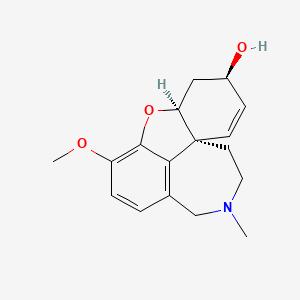
Galantamine is an acetylcholinesterase inhibitor with acute human studies showing task-specific changes in memory and attention and measurable AChE inhibition, but no general cognitive enhancement in healthy adults.
Galantamine is an acetylcholinesterase inhibitor. In healthy adults, single 4 or 8 mg doses inhibited circulating AChE but not BChE; the investigators inferred that central acetylcholine levels were likely increased. [4]
Galantamine challenge altered alpha oscillations during working memory and increased the modeled rate of Bayesian belief updating about spatial-cue validity, linking cholinergic stimulation to task-specific network effects. [2]
Reported experiences are kept separate from measured outcomes and remain tied to their cited context.
What the research measured, for whom, and under which exposure. Findings remain attached to the study’s task or clinical endpoint.
After 8 mg galantamine, retrieval speed during working memory slowed, alpha power decreased, and familiarity-based long-term recognition was impaired. [2]
Galantamine increased the influence of probabilistic cue context on saccadic response speed; modeling attributed this to a higher rate of belief updating rather than altered response mapping. [3]
Galantamine 4 or 8 mg inhibited circulating AChE but not BChE; neither dose improved neurobehavioral performance in young healthy adults, likely because of ceiling effects. [4]
In 16 healthy subjects, galantamine increased the rate of trial-wise belief updating about spatial-cue validity during a Posner task. [3]
Study doses and reference exposures, with route, formulation and duration.
Other routes · Other or unspecified · 2 records
Absorption, metabolism and elimination depend on the analyte, route, formulation, physiology and other exposures.
No pharmacokinetic observation was supplied by this identity import. [1]
Adverse effects and interactions reported in the cited studies.
Galantamine slowed working-memory retrieval and impaired familiarity recognition in one study; another found no neurobehavioral improvement despite AChE inhibition, so these findings do not support use as a general enhancer in healthy people. [2]
Single 4 or 8 mg doses inhibited circulating AChE but not BChE in healthy adults; the abstract reports no neurobehavioral improvement for galantamine and notes possible ceiling effects. [4]
The research-linked studies were acute experiments in healthy adults; dose, formulation, and longer-term tolerability cannot be generalized beyond the tested protocols. [3]
Original publications, findings and available funding disclosures.
Explore the participants, roles and sources behind each relationship.
Within-subject EEG and memory study; not evidence of clinical impairment outside the tested task.
Limitation Abstract does not provide sample size or numeric effect estimates.
Posner spatial-attention task with hierarchical Bayesian modeling.
Limitation Dose was not stated in the PubMed abstract and the finding is task-specific.
Healthy-adult single-dose pharmacology study.
Limitation Acute small sample; clinical populations and longer-term outcomes were not studied.
Content updated Oct 27, 2026.