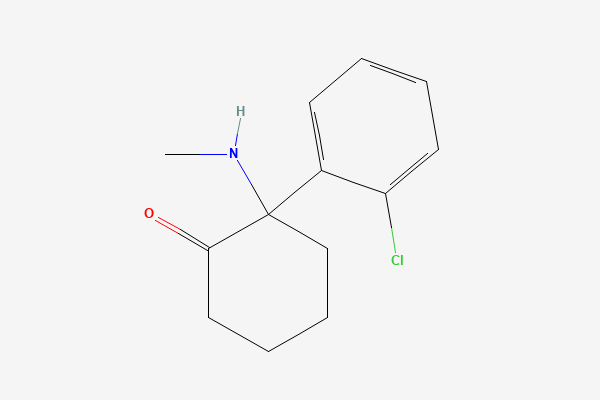
Ketamine has molecular formula C13H16ClNO and molecular weight 237.72 g/mol as the free base; injectable KETALAR contains ketamine hydrochloride. KETALAR labeling identifies the drug as a racemic mixture, whereas SPRAVATO contains esketamine, the S-enantiomer of racemic ketamine. Sources: pubchem, ketalar-label, spravato-label.
Ketamine produces a dissociative anesthetic state with analgesia and characteristic perceptual and neuropsychiatric effects. Its established anesthetic use and the depression indications of intranasal esketamine are distinct regulatory uses and should not be conflated. Racemic IV ketamine has depression-trial evidence, but the cited KETALAR U.S. label does not include depression as an indication. Sources: ketalar-label, spravato-label, murrough-2013.
Racemic ketamine is a nonselective, noncompetitive antagonist of the ionotropic NMDA glutamate receptor. Norketamine also has activity at this receptor but lower affinity. [2]
Esketamine is the S-enantiomer of racemic ketamine and is a nonselective, noncompetitive NMDA-receptor antagonist. The SPRAVATO label states that the mechanism responsible for its antidepressant effect is unknown. [3]
Cardiovascular stimulation
KETALAR labeling attributes ketamine's usual increases in blood pressure, heart rate and cardiac output indirectly to inhibition of central and peripheral catecholamine reuptake. [2]
02
Subjective effects
Reported experiences are kept separate from measured outcomes and remain tied to their cited context.
03
Measured outcomes
What the research measured, for whom, and under which exposure. Findings remain attached to the study’s task or clinical endpoint.
A two-site randomized active-controlled trial found lower MADRS scores 24 hours after ketamine than after midazolam. By day 7, the adjusted MADRS and QIDS between-group differences and response-rate difference were no longer statistically significant. [4]
Populationadults with treatment-resistant major depressionExposureracemic ketamine 0.5 mg/kg IV over 40 minutesMeasureMADRS
In a phase 4 placebo-controlled trial after an antidepressant-free period, both fixed intranasal doses reduced MADRS scores versus placebo at day 28 and approximately 24 hours after the first dose. Characteristic adverse effects created substantial potential for functional unblinding. [5]
Populationadults with treatment-resistant depressionExposureintranasal esketamine 56 mg or 84 mg twice weekly for four weeksMeasureMADRS
Two phase 3 trials found greater 24-hour MADRS improvement with esketamine plus standard care than placebo spray plus standard care. The prespecified secondary CGI-SS-r measure of suicidal ideation and behavior did not show superiority over placebo in either study. [3]
Populationadults with moderate-to-severe MDD and active suicidal ideation and intentExposureesketamine 84 mg intranasally plus standard careMeasureMADRS; CGI-SS-r
A Cochrane review of randomized double-blind controlled trials found a small average reduction in resting pain at 24 hours and lower opioid consumption. CNS adverse events were not clearly increased: 5% with ketamine versus 4% with control, RR 1.2 (95% CI 0.95–1.4). [6]
Populationadults undergoing surgery under general anesthesiaExposureperioperative intravenous ketamineMeasurenormalized VAS
Human research
Study-result plots
1 of 4 findings in this selection lack structured estimates. Different measures, populations, instruments, comparators, or assessment times are shown separately.
04
Doses & routes
Study doses and reference exposures, with route, formulation and duration.
Intranasal · Through the nasal mucosa · 3 records
05
Pharmacokinetics
Absorption, metabolism and elimination depend on the analyte, route, formulation, physiology and other exposures.
Timing explorer
Modeled elimination
The elimination model describes the named analyte after absorption and distribution. It does not establish felt-effect timing.
An elimination model is not established for this observation.
Source-bound record
This observation provides context about the measured record, but it does not support a first-order elimination curve.
Measured analyte
ketamine
Route
intravenous
Formulation
ketamine hydrochloride injection
Population
clinical labeling population
Source context
KETALAR reports an initial alpha phase lasting about 45 minutes with a 10–15 minute half-life and a roughly 2.5-hour redistribution half-life from CNS to slower-equilibrating tissues. These are distribution/redistribution parameters, not a reported terminal elimination half-life.
The current KETALAR label reports a 10–15 minute IV alpha-phase half-life and about 2.5 hours for redistribution from the CNS to slower-equilibrating tissues; neither is presented as a terminal elimination half-life. Intranasal esketamine has a separately reported terminal half-life of 7–12 hours. [2]
Sourced elimination observations
Bioavailability
The cited KETALAR label does not establish absolute bioavailability for non-IV racemic-ketamine routes. [2]
Metabolism / metabolites
Ketamine undergoes N-dealkylation to active norketamine, primarily through CYP2B6 and CYP3A4; norketamine is subsequently hydroxylated and conjugated. [2]
Factors that change the estimate
06
Safety & uncertainty
Adverse effects and interactions reported in the cited studies.
Warning
Cardiovascular effects
Ketamine frequently causes transient increases in blood pressure, heart rate and cardiac index, although hypotension, bradycardia, arrhythmias and cardiac decompensation have also occurred. With anesthetic ketamine, systolic and diastolic pressure commonly peak 10–50% above baseline. Intranasal esketamine raises blood pressure at all recommended doses; 3–19% of treated patients versus 1–4% of placebo recipients had at least one rise of at least 40 mmHg systolic and/or 25 mmHg diastolic during the first four weeks. [3]
Monitor
Neuropsychiatric, sedative and respiratory effects
KETALAR emergence reactions occur in approximately 12% of patients and can include dream-like states, vivid imagery, hallucinations, confusion, agitation or delirium; psychiatric adverse events have also been reported to persist for days to weeks. SPRAVATO trials recorded sedation in 48–61% and loss of consciousness in 0.3–0.4%. Respiratory depression can occur with rapid or excessive ketamine exposure, and postmarketing esketamine reports include respiratory depression and rare respiratory arrest. [2]
Context
Urinary and hepatobiliary injury with recurrent exposure
Long-term ketamine use or abuse has been associated with cystitis, reduced bladder capacity, ureteral stenosis or obstruction, hydronephrosis and renal impairment, and with cholestatic hepatobiliary dysfunction, biliary strictures and sclerosing cholangitis. SPRAVATO trials had more lower-urinary-tract symptoms than placebo but no esketamine-related interstitial cystitis in studies extending to one year. [2]
Warning
Abuse, tolerance and dependence
Ketamine and esketamine are Schedule III controlled substances in the United States. Prolonged ketamine exposure can produce tolerance and physical dependence. Withdrawal described after frequent, long-term high-dose exposure includes craving, fatigue, poor appetite and anxiety. Recurrent high-dose misuse or abuse may also be associated with memory or attention impairment. [2]
Monitor
Pregnancy and developmental uncertainty
Human ketamine pregnancy data are concentrated around cesarean anesthesia and have not identified a drug-associated maternal or fetal risk, but the evidence is limited by small samples, retrospective collection and absent long-term follow-up; data for other stages of pregnancy are insufficient to estimate major malformation or miscarriage risk. Animal studies of ketamine or esketamine show developmental toxicity, and prolonged NMDA-blocking anesthetic exposure during fetal brain development causes neuronal apoptosis in primates; the clinical significance for humans remains uncertain. [2]
Track the markers below alongside the cited treatment context. Targets are reference ranges and response goals, not a substitute for clinical judgment.
No established target; track the peak against the individual's own first session
Quantifies dissociation so escalation can be detected. [3]
Cadence: Baseline liver panel, kidney function and urine dipstick within two weeks of starting. Blood pressure and heart rate every 10 minutes per session until baseline returns. Symptom scores at 24 hours after the first dose, then weekly through induction. Urine dipstick and liver enzymes at 3 months, then every 6 months while dosing continues, and immediately if urinary symptoms appear.
08
Research & sources
7
Original publications, findings and available funding disclosures.
09
Connected claims
Explore the participants, roles and sources behind each relationship.
evidence-assessmentAuthored relationship
Racemic ketamine is U.S.-approved to treat depression.
The current KETALAR label covers anesthesia, not depression. Randomized trials support antidepressant effects of IV racemic ketamine, while the separately regulated S-enantiomer esketamine has U.S. depression indications as SPRAVATO.
Limitation Regulatory status is jurisdiction- and product-specific.
evidence-assessmentAuthored relationship
SPRAVATO has been shown to prevent suicide or reduce suicidal ideation or behavior.
The U.S. label explicitly states that effectiveness for preventing suicide or reducing suicidal ideation or behavior has not been demonstrated. In the two acute-suicidal-MDD trials, depressive symptoms improved more on MADRS, but the CGI-SS-r suicidality secondary endpoint did not show superiority.
Limitation The null finding concerns the studied suicidality measure and does not erase the antidepressant MADRS finding.
evidence-assessmentAuthored relationship
Ketamine pain studies establish broad or durable analgesic efficacy across pain disorders.
Perioperative randomized evidence supports modest average reductions in acute postoperative pain and opioid consumption. The heterogeneous evidence does not by itself establish a general long-term pain indication, and KETALAR's cited U.S. indications remain anesthetic.
Limitation The cited pooled evidence concerns perioperative acute pain rather than every chronic pain condition or dosing strategy.