The substance library

ZeaxanthinA macular xanthophyll carotenoid with mixed standalone human supplementation evidence

Also known as: 3R,3'R-zeaxanthin · all-trans-zeaxanthin · beta,beta-carotene-3,3'-diol · zeaxanthol

Standalone zeaxanthin at approximately 8–20 mg/day can raise serum zeaxanthin and sometimes MPOD, but responses are inconsistent and clinical vision or disease benefits are unproven. AREDS2, pediatric eye-strain and food-matrix trials are combination evidence and cannot be assigned to zeaxanthin alone.
19 sourcesContent date Oct 10, 2026CompareExplore connectionsRevision history
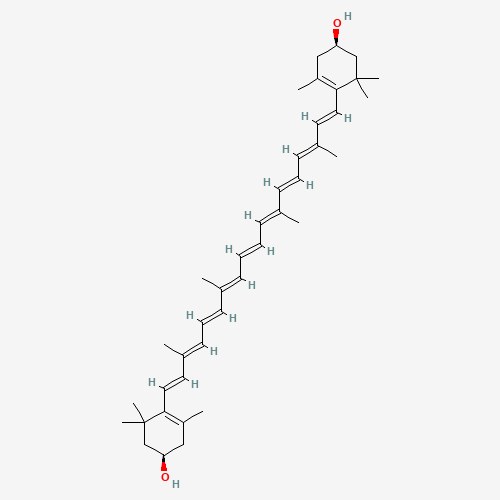
Zeaxanthin molecular structure
PubChem
01

Overview

Zeaxanthin, meso-zeaxanthin and lutein are distinct retinal carotenoids. This record separates standalone zeaxanthin from lutein/zeaxanthin mixtures, Lycium food interventions and multi-ingredient supplements.

How it works

Macular pigment deposition

Zeaxanthin accumulates in retinal pigment regions, but spatial distribution depends on baseline retinal anatomy and disease. [2]

Short-wavelength light filtering

Macular zeaxanthin absorbs short-wavelength light and may influence glare or contrast; this does not prove retinal disease treatment. [11]

Formulation-dependent exposure

Micronization and oil matrices can raise serum exposure without demonstrating proportionally greater retinal accumulation or benefit. [14]

02

Subjective effects

Reported experiences are kept separate from measured outcomes and remain tied to their cited context.

Variable
Human research

ZVF reported a numerical high-contrast acuity improvement in the zeaxanthin arm, but lutein was an active comparator and several contrast or glare outcomes were trends rather than conventional significant effects. [5]

Population
Adults with atrophic AMD
Exposure context
8 mg/day zeaxanthin for 1 year
03

Measured outcomes

What the research measured, for whom, and under which exposure. Findings remain attached to the study’s task or clinical endpoint.

LUXEA investigators estimated approximately 14% MPOD increase after correction for zeaxanthin deposition at the parafoveal reference location. [2]

PopulationHealthy volunteers in LUXEAExposureStandalone zeaxanthin 10–20 mg/dayMeasureHeterochromatic flicker photometry
Human research

10 mg/day zeaxanthin did not consistently raise MPOD over 3 months, unlike the lutein arm in non-high-myopic participants. [7]

Population22 healthy Japanese adultsExposure10 mg/day zeaxanthinMeasureMPOD measurement
Human research

The standalone zeaxanthin arm showed reported acuity improvement, but active lutein control, small sample and multiple outcomes limit causal certainty. [5]

Population60 adults with mild-to-moderate atrophic AMDExposure8 mg/day zeaxanthin for 1 yearMeasureHigh-contrast visual acuity
Human research

Zeaxanthin increased pigment in a preserved perifoveal ring but did not restore the central foveal deficit; acuity, contrast and OCT did not improve. [8]

Population8 adults with MacTel2Exposure10 or 20 mg/day for up to 24 monthsMeasureMPOD, visual tests and OCT
Human research

AREDS2 tested 10 mg lutein + 2 mg zeaxanthin within an antioxidant/mineral formula and found no significant overall added protection; findings cannot be assigned to zeaxanthin alone. [17]

Population4,203 adults with high-risk AMDExposureAREDS2 combination formulaMeasureAdvanced AMD progression
Human research

Micronized oil-based formulation increased serum zeaxanthin exposure compared with a reference formulation; retinal accumulation and clinical benefit were not measured. [14]

Population90 healthy menExposure2 mg zeaxanthin + 10 mg lutein single doseMeasureSerum Cmax and AUC
Human research
04

Doses & routes

Study doses and reference exposures, with route, formulation and duration.

Oral · By mouth · 6 records

Zeaxanthin and Visual Function Study

Research exposure

8 mg/day [5]

Ingredient / form
Zeaxanthin · Study softgel
Route
oral
Frequency
daily
Duration
1 year
Population
60 adults with mild-to-moderate atrophic AMD
Purpose
Assess MPOD and visual function

Lutein was an active comparator; no inert placebo.

Japanese MPOD trial

Research exposure

10 mg/day [7]

Ingredient / form
Zeaxanthin · Study supplement
Route
oral
Frequency
daily
Duration
3 months
Population
22 healthy Japanese adults with and without high myopia
Purpose
Assess MPOD

Standalone zeaxanthin did not consistently increase MPOD.

MacTel2 trial

Research exposure

10–20 mg/day [8]

Ingredient / form
Zeaxanthin · High-dose zeaxanthin supplement
Route
oral
Frequency
daily
Duration
Up to 24 months
Population
8 adults with macular telangiectasia type 2
Purpose
Assess retinal pigment and function

One participant developed reversible inner-retinal crystalline deposits at 20 mg/day.

LUXEA supplementation

Research exposure

10–20 mg/day [2]

Ingredient / form
Zeaxanthin · Actilease/OPTISHARP zeaxanthin
Route
oral
Frequency
daily
Duration
6–12 months
Population
Healthy volunteers
Purpose
Assess retinal pigment accumulation and visual performance

Standalone and combination arms were studied separately.

Formulation PK study

Research exposure

2 mg zeaxanthin [14]

Ingredient / form
Zeaxanthin · Micronized oil-based Ocusorb versus reference formulation
Route
oral
Frequency
single dose
Duration
Sampling through 72 hours
Population
90 healthy men
Purpose
Compare serum bioavailability

Combination dose; OmniActive funded the study and supplied products.

Pediatric combination trial

Research exposure

2 mg zeaxanthin/day [15]

Ingredient / form
Zeaxanthin · Gummy combination
Route
oral
Frequency
daily
Duration
180 days
Population
60 children aged 5–12 years
Purpose
Assess MPOD and eye-strain outcomes

Combination evidence; zeaxanthin-specific contribution cannot be isolated.

05

Pharmacokinetics

Absorption, metabolism and elimination depend on the analyte, route, formulation, physiology and other exposures.

Timing explorer

Published timing evidence
The source reports timing terms but does not provide numeric elapsed intervals.
Onset
Serum appearance occurs after oral dosing; exact onset depends on formulation.
Peak
A formulation study sampled serum from 2–72 h; no universal Tmax was adopted here.
Duration
MPOD and retinal outcomes were assessed over months; subjective or clinical duration is not established.

Not established as a numeric timeline. Plasma timing and felt effects are distinct measurements. Source

Modeled elimination

The elimination model describes the named analyte after absorption and distribution. It does not establish felt-effect timing.

oral · 2 mg zeaxanthin + 10 mg lutein; two formulations · not-established

Not modeled

Elimination model

An elimination model is not established for this observation.

Source-bound record

This observation provides context about the measured record, but it does not support a first-order elimination curve.

Measured analyte
zeaxanthin
Route
oral
Formulation
2 mg zeaxanthin + 10 mg lutein; two formulations
Population
90 healthy men

Source context

Micronized formulation produced approximately 1.75-fold higher Cmax and 2.2-fold higher AUC than reference through 72 h; no terminal half-life was established.
Read source context
Review the supporting record and source details.

Human supplementation studies report serum exposure and 72-hour sampling, but no validated universal terminal half-life for zeaxanthin. [14]

Sourced elimination observations

zeaxanthin

No numeric estimate

Not established [14]

Route / formulation
oral · 2 mg zeaxanthin + 10 mg lutein; two formulations
Population
90 healthy men

Micronized formulation produced approximately 1.75-fold higher Cmax and 2.2-fold higher AUC than reference through 72 h; no terminal half-life was established.

Bioavailability
Oil-based micronized formulation increased serum Cmax and AUC relative to reference. [14]
Metabolism / metabolites
Zeaxanthin is transported in lipoproteins and deposited in macular pigment; distribution differs from lutein. [14]

Factors that change the estimate

Formulation

Serum exposure changes materially

Micronized oil-based formulation increased Cmax and AUC versus reference in a small commercial PK study. [14]

Related observation

Baseline retinal pigment

Retinal distribution may limit response

MacTel2 and Japanese MPOD findings show that baseline retinal geography and myopia status affect measured response. [8]

Related observation

Combination products

Attribution is limited

Lutein, meso-zeaxanthin, Lycium and other nutrients are frequently co-administered. [15]

Related observation
06

Safety & uncertainty

Adverse effects and interactions reported in the cited studies.

Warning

Retinal crystalline deposits

One MacTel2 participant developed yellowish hypofluorescent inner-retinal deposits at 20 mg/day; deposits resolved after stopping and did not establish incidence. [8]

Monitor

Combination evidence

AREDS2, pediatric gummies and food interventions include lutein or other ingredients and cannot establish zeaxanthin-alone efficacy. [17]

Context

Pregnancy and lactation

Available pregnancy evidence is combination-only and did not establish lactation transfer or long-term postpartum safety. [12]

Warning

Organ impairment

No dedicated standalone zeaxanthin study in significant renal or hepatic impairment was identified. [14]

Monitor

Commercial sponsorship

ZVF, LUXEA and formulation studies include industry sponsors or product suppliers; funding and COI remain relevant to interpretation. [6]

Interactions in cited sources

Explore a pair of substances

Prescription medicines

No controlled published human trial established a clinically important zeaxanthin–medication interaction. [14]

Context
Interaction status not assessed.

Lutein and other carotenoids

Co-administered lutein, meso-zeaxanthin and food matrices can confound attribution and may alter absorption. [2]

Context
Formulation and mixture dependent.
07

Research & sources

19

Original publications, findings and available funding disclosures.

08

Connected claims

Explore the participants, roles and sources behind each relationship.

evidence-boundaryAuthored relationship

Standalone zeaxanthin can raise MPOD

Some studies show increased MPOD, while another randomized Japanese study was null.

Limitation Response is inconsistent and MPOD is a surrogate.

evidence-boundaryAuthored relationship

Zeaxanthin prevents or treats AMD

Zeaxanthinintervention
Attentionreported-outcome-context

No robust standalone trial establishes disease modification; AREDS2 is a combination intervention.

Limitation Small active-comparator studies and mixture evidence cannot establish monotherapy.

evidence-boundaryAuthored relationship

Zeaxanthin is a nootropic

Zeaxanthinintervention
Attentionreported-outcome-context

No published standalone randomized efficacy trial establishing cognitive benefit was located.

Limitation Positive cognitive findings come from combination products.

Explore the relationship graph
10

Publication history

Content updated Oct 10, 2026.

Keep exploring

View graph