The substance library

Choline bitartrateNootropic

Also known as: Choline tartrate · Choline hydrogen tartrate · Choline bitartrate, anhydrous · (2-Hydroxyethyl)trimethylammonium-L-(+)-tartrate salt (1:1)

Choline bitartrate is a hygroscopic 1:1 choline/L-hydrogen-tartrate salt containing about 41.1% choline by mass. Human evidence shows no acute memory benefit in healthy young adults, a visuomotor speed–accuracy shift, and reproducible choline/TMAO exposure effects; disease-population findings do not establish healthy-person cognitive enhancement.
18 sourcesContent date Oct 10, 2026CompareExplore connectionsRevision history
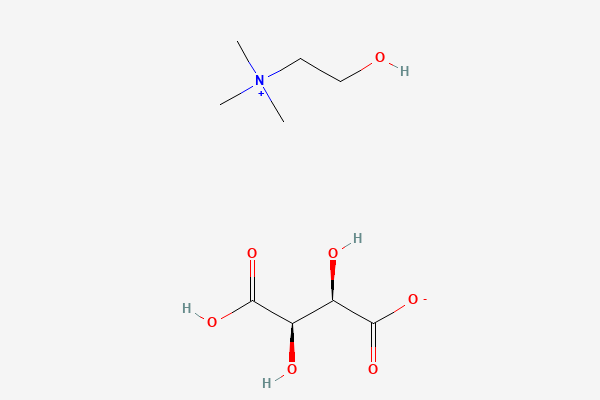
Choline bitartrate molecular structure
PubChem
01

Overview

Choline bitartrate (CAS 87-67-2; PubChem CID 6900) is the 1:1 choline/L-(+)-hydrogen-tartrate salt, with about 41.1% choline-equivalent by mass in the pure anhydrous form. FCC describes a white hygroscopic crystalline powder, freely water-soluble, slightly alcohol-soluble, and ether/chloroform-insoluble. PubChem compiles manufacturing and legacy identity/assay methods; finished-product moisture and excipients can change delivered salt mass.

How it works

Choline precursor and structural-lipid pathways

Choline released from choline bitartrate can supply substrate for acetylcholine synthesis, phosphatidylcholine and sphingomyelin metabolism, and oxidation to betaine. Precursor availability alone does not demonstrate increased brain acetylcholine or cognitive benefit after this formulation. [1]

Gut-microbial trimethylamine and hepatic TMAO formation

Unabsorbed or gut-accessible free choline can be converted by intestinal microbes to trimethylamine, which is oxidized primarily by hepatic flavin-containing monooxygenase activity to TMAO. Choline-bitartrate TMAO responses vary markedly among individuals and with microbiome composition. [9]

02

Subjective effects

Reported experiences are kept separate from measured outcomes and remain tied to their cited context.

Increased
Human research

A 2-g crossover found more centrally placed hits after dosing, accompanied by slower reaction times; this is a speed–accuracy shift rather than general cognitive enhancement. [6]

Population
28 healthy adults
Exposure context
2 g oral choline bitartrate, acute
03

Measured outcomes

What the research measured, for whom, and under which exposure. Findings remain attached to the study’s task or clinical endpoint.

Acute 2.0–2.5 g salt doses produced no reliable memory benefit; Bayesian analyses generally favored the null. [18]

PopulationHealthy young adultsExposure2.0–2.5 g oral choline bitartrateMeasureVisuospatial, picture and verbal working-memory tasks
Human research

Serum choline rose after 2.43 g bitartrate, but work performed and time to fatigue did not improve in trained cyclists. [7]

Population20 trained male cyclistsExposure2.43 g oral choline bitartrate before exerciseMeasureCycling work and time-to-fatigue test
Human research

Water-soluble bitartrate increased plasma TMAO more than phosphatidylcholine in controlled comparisons; responder variability was substantial. This is a biomarker, not proof of cardiovascular harm. [9]

PopulationHealthy adultsExposure600 mg choline-equivalent as bitartrateMeasurePlasma TMAO AUC
Human research

Completed preschool FASD trials show a qualified memory signal, strongest in younger children, without consistent IQ or executive-function benefit. [12]

Population104 preschool children pooled across three placebo-controlled trialsExposureApproximately 260–500 mg/day choline-equivalent as bitartrateMeasureSequential-memory and developmental measures
Human research

Choline is a dietary component and precursor of acetylcholine, a crucial neurotransmitter for memory-related brain functions. [5]

PopulationPopulation described in the PubMed abstractExposureCholine is a dietary component and precursor of acetylcholine, a crucial neurotransmitter for memory-related brain functions.MeasureNot assessed
Human research
04

Doses & routes

Study doses and reference exposures, with route, formulation and duration.

Oral · By mouth · 5 records

Equal-choline crossover PK exposure

Research exposure

1,336 mg salt [10]

Ingredient / form
Choline bitartrate · Oral salt dissolved for randomized crossover comparison
Route
Oral
Frequency
Single dose
Duration
24-hour sampling
Population
Six healthy adult men
Purpose
Compare choline and metabolite kinetics across choline forms

Equal-choline comparator; not a dosing recommendation.

TMAO biomarker trial

Research exposure

1,000 mg salt [11]

Ingredient / form
Choline bitartrate · Two independently assayed 500-mg tablets daily
Route
Oral
Frequency
Once daily
Duration
4 weeks
Population
Adults with normal renal function
Purpose
Plasma and urinary TMAO/platelet biomarker research

The choline fraction is a stoichiometric conversion; cardiovascular events were not studied.

Acute cognition crossover

Research exposure

2–2.5 g salt [18]

Ingredient / form
Choline bitartrate · Oral food-supplement salt
Route
Oral
Frequency
Single dose
Duration
Acute cognitive testing
Population
Healthy young adults
Purpose
Memory and visuomotor research

No reliable memory benefit; a separate study found a precision/speed trade-off.

Cycling fatigue study

Research exposure

2.43 g salt [7]

Ingredient / form
Choline bitartrate · Oral supplement
Route
Oral
Frequency
Single pre-exercise exposure
Duration
Acute cycling session
Population
20 trained male cyclists
Purpose
Exercise-fatigue research

Serum choline increased, but work and time to fatigue did not.

Pediatric FASD trials

Research exposure

260–500 mg/day choline-equivalent [12]

Ingredient / form
Choline bitartrate · Pediatric trial preparation
Route
Oral
Frequency
Daily
Duration
3–9 months in completed trials
Population
Preschool children with fetal alcohol spectrum disorders
Purpose
Developmental-memory research

Specialized disease-population evidence; fishy body odor was the reproducible treatment-attributed event.

05

Pharmacokinetics

Absorption, metabolism and elimination depend on the analyte, route, formulation, physiology and other exposures.

Timing explorer

Measured plasma timing · Choline
Oral · Meal containing 600 mg choline supplied as choline bitartrate

37 healthy men

Elapsed timingEach pair of points is an independent reported range; color follows the reported phase.
hours
Peak
  • Peak: 1 h–1 h

Plasma free choline peaked at approximately 1 hour after the choline-bitartrate meal and by 6 hours was not different from the no-choline control; this is an observed concentration-time window, not an elimination half-life.

Reported ranges retain the source context. Phase durations are not added together to construct a timeline. Source

Modeled elimination

The elimination model describes the named analyte after absorption and distribution. It does not establish felt-effect timing.

Oral · 1,336 mg choline bitartrate supplying 550 mg choline-equivalent · not-established

Not modeled

Elimination model

An elimination model is not established for this observation.

Source-bound record

This observation provides context about the measured record, but it does not support a first-order elimination curve.

Measured analyte
Plasma free choline
Route
Oral
Formulation
1,336 mg choline bitartrate supplying 550 mg choline-equivalent
Population
Six healthy adult men

Source context

Median free-choline Tmax was approximately 1.75 hours and concentrations approached baseline by 24 hours. The study measured released choline, not intact salt terminal elimination.
Read source context
Review the supporting record and source details.

Human concentration-time studies measured choline and metabolites for up to 24 hours after oral choline bitartrate but did not establish a validated elimination half-life for the salt or released choline. [10]

Sourced elimination observations

Plasma free choline

No numeric estimate

Not established [10]

Route / formulation
Oral · 1,336 mg choline bitartrate supplying 550 mg choline-equivalent
Population
Six healthy adult men

Median free-choline Tmax was approximately 1.75 hours and concentrations approached baseline by 24 hours. The study measured released choline, not intact salt terminal elimination.

Plasma betaine and dimethylglycine

No numeric estimate

Not established [12]

Route / formulation
Oral · Commercial choline-bitartrate reference product
Population
Healthy adult volunteers in a randomized crossover

Free choline remained elevated through eight hours, with downstream betaine and dimethylglycine increases; no validated terminal half-life was fitted.

Plasma TMAO

No numeric estimate

Not established [9]

Route / formulation
Oral · 600 mg choline-equivalent as choline bitartrate
Population
Healthy adults in a double-blind crossover meal study

Bitartrate produced a substantially larger six-hour TMAO response than control or phosphatidylcholine, with strong responder variability. TMAO AUC is a biomarker and cannot populate a drug half-life model.

Plasma TMAO

No numeric estimate

Not established [11]

Route / formulation
Oral · Two 500-mg choline-bitartrate tablets daily
Population
Adults with normal renal function

Median fasting TMAO rose from about 1.9 to 11.1 micromol/L after four weeks; this is a repeated-exposure biomarker result, not evidence of clinical cardiovascular events.

Bioavailability
Oral choline bitartrate increases circulating choline, but systemic exposure differs by formulation and study; free versus phospholipid-bound choline also differs substantially in gut conversion to TMAO. [10]
Metabolism / metabolites
Released choline can enter phosphatidylcholine and acetylcholine pathways, be oxidized to betaine, or undergo gut-microbial conversion to trimethylamine followed by hepatic oxidation to trimethylamine N-oxide. [10]
06

Safety & uncertainty

Adverse effects and interactions reported in the cited studies.

Warning

Salt mass is not choline-equivalent

Pure anhydrous choline bitartrate is about 41.1% choline by mass. Product moisture, assay and excipients can change delivered choline; trial salt doses cannot be copied as universal choline targets. [1]

Monitor

Excess-choline adverse effects

NIH guidance for total choline lists fishy body odor, vomiting, sweating, salivation, hypotension and liver toxicity at excessive intake. This is a nutrient-level warning, not bitartrate-specific incidence evidence. [4]

Context

Pediatric FASD evidence is specialized

FASD studies are narrow pediatric disease-population trials. Fishy body odor was the reproducible treatment-attributed event, and attrition-prone follow-up does not establish durable general benefit. [12]

Warning

TMAO is an intermediate biomarker

Several bitartrate studies raise TMAO, but they were not powered for myocardial infarction, stroke, thrombosis or mortality; renal-function and gut-microbiome context affect interpretation. [11]

Interactions in cited sources

Explore a pair of substances
07

Research & sources

18

Original publications, findings and available funding disclosures.

Reports elsewhere

This link leaves BHWiki for an outside experience index. It is not a finding, a dose, or a source for the claims above. The report text is not stored here.

08

Connected claims

Explore the participants, roles and sources behind each relationship.

did-not-improveAuthored relationship

Acute 2.0–2.5 g choline bitartrate did not improve the tested visuospatial, declarative, or verbal memory outcomes in healthy young adults.

Three placebo-controlled crossover experiments tested memory approximately 60 minutes after oral administration.

Limitation These acute studies do not exclude effects in deficient, diseased, developmental, older, or chronically supplemented populations.

alteredAuthored relationship

A 2 g acute choline-bitartrate dose shifted healthy participants toward greater visuomotor aiming precision with slower responses rather than improving overall task score.

Choline bitartrateintervention
Reaction timemeasured-outcome

Double-blind placebo-controlled crossover study of 28 healthy young adults assessed approximately 70 minutes after administration.

Limitation Small single-center study; total task score was unchanged and the finding is not evidence of general cognitive enhancement.

increasesAuthored relationship

Oral choline bitartrate commonly increases circulating TMAO in human intervention studies, with substantial interindividual variation and formulation dependence.

Choline bitartratecholine-source

Supported by acute feeding, four-week supplementation, and randomized crossover studies in generally healthy adults.

Limitation TMAO magnitude is heterogeneous, and biomarker elevation alone does not establish downstream clinical cardiovascular or metabolic harm.

associated-withAuthored relationship

Choline bitartrate is associated with the reported episodic memory finding in this publication.

Choline bitartrateintervention or exposure
Episodic memoryreported endpoint

Publication abstract; direction and population are retained on the linked observation.

Limitation Automated corpus import from an abstract; this record is not an independent meta-analysis.

Explore the relationship graph
10

Publication history

Content updated Oct 10, 2026.

Keep exploring

View graph