The substance library

DihexaExperimental compound

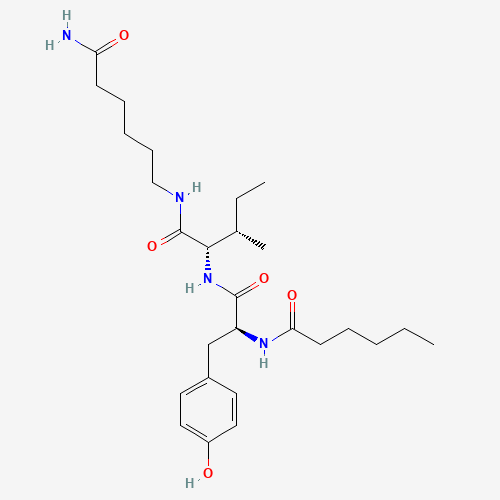
Also known as: dihexa · PNB-0408 · N-hexanoyl-Tyr-Ile-(6)-aminohexanamide

Dihexa is a synthetic angiotensin-IV-derived peptidomimetic reported in rat PK and cognition studies.
25 sourcesContent date Oct 11, 2026CompareExplore connectionsRevision history
Dihexa molecular structure
PubChem
01

Overview

The CAS-linked record identifies C27H44N4O5 and CID 129010512; a separate PNB-0408 PubChem entry is not merged without stereochemical verification. [dh-pubchem] [dh-pubchem-pnb]

How it works

Proposed HGF/c-MET potentiation

The 2014 paper reported allosteric HGF modulation and enhanced c-MET phosphorylation, but that paper was retracted; these are historical claims rather than established mechanisms. [4]

Growth and invasion pathway context

HGF/MET signaling participates in growth, survival, motility, angiogenesis, invasion and metastasis biology. This creates a mechanistic tumor concern, not evidence of Dihexa-specific human cancer. [9]

Preclinical synaptic signaling

Reported synaptic and electrophysiological effects were observed in cell or rat models and do not establish human cognitive efficacy. [4]

Angiotensin-IV analog stabilization and barrier permeability

PMID 23055539 reports chemical modifications yielding orally active, blood-brain-barrier-permeant dihexa with rat scopolamine and aged-model procognitive activity; this is a preclinical report and does not validate human mechanism. [25]

Research mechanism

Source-specific mechanism detail is preserved in the cited source. [15]

Research mechanism

Source-specific mechanism detail is preserved in the cited source. [15]

Research mechanism

Source-specific mechanism detail is preserved in the cited source. [20]

Research mechanism

Source-specific mechanism detail is preserved in the cited source. [20]

02

Subjective effects

Reported experiences are kept separate from measured outcomes and remain tied to their cited context.

Increased
Limited research

Increased dendritic-spine density and synaptic-marker changes were reported in rat hippocampal preparations; the central mechanistic paper was retracted. [4]

Population
Cultured rat hippocampal neurons and slices
Exposure context
Experimental Dihexa exposure
Increased
Limited research

Morris water-maze deficit reversal was reported in scopolamine-impaired rats; the evidence is animal-only and integrity-compromised. [3]

Population
Scopolamine-impaired rats
Exposure context
2 mg/kg oral Dihexa
Variable
Human research

Source-specific effect evidence is preserved in the cited reference. [15]

Variable
Human research

Source-specific effect evidence is preserved in the cited reference. [15]

Variable
Human research

Source-specific effect evidence is preserved in the cited reference. [14]

Variable
Human research

Source-specific effect evidence is preserved in the cited reference. [21]

03

Measured outcomes

What the research measured, for whom, and under which exposure. Findings remain attached to the study’s task or clinical endpoint.

A rat behavioral improvement was reported, but the relevant foundational papers carry a Notice of Concern or retraction. [3]

PopulationScopolamine-impaired ratsExposure2 mg/kg oral DihexaMeasureMorris water maze
Limited research

No registered or published human Dihexa efficacy outcome was located. [10]

PopulationHumans; no verified study locatedExposureNo clinical exposure establishedMeasureClinicalTrials.gov and PubMed searches
Limited research

Source-specific outcome evidence is preserved in the cited reference. [21]

PopulationNot establishedExposureNot establishedMeasureNot assessed
Human research

Source-specific outcome evidence is preserved in the cited reference. [21]

PopulationNot establishedExposureNot establishedMeasureNot assessed
Human research

Source-specific outcome evidence is preserved in the cited reference. [21]

PopulationNot establishedExposureNot establishedMeasureNot assessed
Human research

Source-specific outcome evidence is preserved in the cited reference. [14]

PopulationNot establishedExposureNot establishedMeasureNot assessed
Human research

The preclinical paper reports that orally active, blood-brain-barrier-permeant dihexa reversed scopolamine-induced deficits in Morris water-maze performance in rats and augmented hippocampal synaptogenesis; it is not human evidence. [25]

PopulationScopolamine-impaired and aged ratsExposureDihexa in rat preclinical experiments; exact schedules are in the full text/curated dh-pk recordMeasureMorris water maze and hippocampal synaptogenesis assays
Limited research
04

Doses & routes

Study doses and reference exposures, with route, formulation and duration.

Oral · By mouth · 2 records

Rat oral cognitive experiment

Research exposure

2 mg/kg [4]

Ingredient / form
Dihexa · Experimental preparation
Route
Oral
Frequency
Study-specific
Duration
Morris water maze study
Population
Scopolamine-impaired rats
Purpose
Research exposure

Reported in a paper later retracted; not a human-equivalent dose.

dihexa research exposure 3

Research exposure

2 mg/kg [15]

Ingredient / form
dihexa
Route
Oral
Purpose
Scopolamine-amnesia Morris water maze experiment

Source-specific research exposure details are preserved in the cited source.

05

Pharmacokinetics

Absorption, metabolism and elimination depend on the analyte, route, formulation, physiology and other exposures.

Elimination half-life · Dihexa
Rat-only observations: 5.6 h serum stability; ~304 h IV terminal estimate; no human half-life

Timing explorer

Published timing evidence
The source reports timing terms but does not provide numeric elapsed intervals.
Peak
Radiolabeled brain accumulation was reported in rats at 30 minutes.

Not established as a numeric timeline. Plasma timing and felt effects are distinct measurements. Source

Modeled elimination

The elimination model describes the named analyte after absorption and distribution. It does not establish felt-effect timing.

Intravenous · Dihexa solution · study-mean

Not modeled

Elimination model

An elimination model is not established for this observation.

Source-bound record

This observation provides context about the measured record, but it does not support a first-order elimination curve.

Measured analyte
Dihexa
Route
Intravenous
Formulation
Dihexa solution
Population
Three rats

Source context

Reported in-vivo terminal half-life 18,256 ± 7,787 minutes after 10 mg/kg IV; animal-specific and not a human estimate.
Read source context
Review the supporting record and source details.

The two numeric observations are rat-specific and sourced from a Dihexa PK paper carrying a Notice of Concern. Human PK was not located. [3]

Sourced elimination observations

Dihexa

Study mean

5.59 hours [3]

Route / formulation
In vitro rat serum · Dihexa assay
Population
Rat serum stability experiment

Reported in-vitro rat-serum half-life 335.5 ± 9.5 minutes; animal-specific and from a paper under Notice of Concern.

Dihexa

Study mean

304.27 hours [3]

Route / formulation
Intravenous · Dihexa solution
Population
Three rats

Reported in-vivo terminal half-life 18,256 ± 7,787 minutes after 10 mg/kg IV; animal-specific and not a human estimate.

Parent compound or reported analyte

No numeric estimate

Not established [2]

Population
Humans

Source-specific pharmacokinetic detail is preserved in the cited source.

Parent compound or reported analyte

No numeric estimate

Not established [2]

Population
Humans

Source-specific pharmacokinetic detail is preserved in the cited source.

Parent compound or reported analyte

No numeric estimate

Not established [2]

Population
Humans

Source-specific pharmacokinetic detail is preserved in the cited source.

Parent compound or reported analyte

No numeric estimate

Not established [21]

Population
Humans

Source-specific pharmacokinetic detail is preserved in the cited source.

Parent compound or reported analyte

No numeric estimate

Not established [2]

Population
Humans

Source-specific pharmacokinetic detail is preserved in the cited source.

Bioavailability
Human oral bioavailability is unknown. [3]
Metabolism / metabolites
Human metabolism, metabolites and clearance are unknown. [3]

Factors that change the estimate

HGF antagonist Hinge

Reportedly blocked Dihexa-associated spinogenesis and mEPSC changes

Experimental pathway probe in the retracted 2014 paper; not a clinical co-treatment. [4]

Related observation

c-MET shRNA

Reportedly blocked spine-induction effects

Experimental target manipulation in a retracted paper; no human validation. [4]

Related observation

Modifier 1

Variable

Source-specific modifier evidence is preserved in the cited reference. [15]

Related observation

Modifier 2

Variable

Source-specific modifier evidence is preserved in the cited reference. [15]

Related observation

Modifier 3

Variable

Source-specific modifier evidence is preserved in the cited reference. [15]

Related observation
06

Safety & uncertainty

Adverse effects and interactions reported in the cited studies.

Warning

Human exposure unknown

No verified human dose, PK, efficacy, safety or adverse-event dataset was located. [10]

Monitor

Data integrity

Two central papers were retracted and a Dihexa-focused PK/behavior paper carries a Notice of Concern; foundational findings require qualification. [5]

Context

Tumor-pathway concern

HGF/MET biology supports a theoretical concern about potentiating growth or invasion pathways; no Dihexa-specific human tumor signal has been demonstrated. [9]

Warning

Rodent PK is not human PK

Rat serum and IV terminal half-lives cannot define human accumulation, schedule or safety. [3]

Monitor

Research caution

Source-specific caution detail is preserved in the cited source. [21]

Context

Research caution

Source-specific caution detail is preserved in the cited source. [14]

Warning

Research caution

Source-specific caution detail is preserved in the cited source. [20]

Monitor

Research caution

Source-specific caution detail is preserved in the cited source. [16]

Context

Research caution

Source-specific caution detail is preserved in the cited source. [14]

Interactions in cited sources

Explore a pair of substances

HGF antagonist Hinge

Used as an experimental pathway probe; no clinical interaction guidance follows. [4]

Context
Mechanistic experiment, not a human drug interaction.

c-MET shRNA

Used as an experimental target manipulation; no clinical interaction guidance follows. [4]

Context
Mechanistic experiment, not a human drug interaction.

Documented or hypothesized coexposure

Source-specific interaction detail is preserved in the cited source. [21]

Context
Evidence context preserved from Deep Research

Documented or hypothesized coexposure

Source-specific interaction detail is preserved in the cited source. [15]

Context
Evidence context preserved from Deep Research

Documented or hypothesized coexposure

Source-specific interaction detail is preserved in the cited source. [15]

Context
Evidence context preserved from Deep Research

Documented or hypothesized coexposure

Source-specific interaction detail is preserved in the cited source. [20]

Context
Evidence context preserved from Deep Research
07

Research & sources

25

Original publications, findings and available funding disclosures.

08

Connected claims

Explore the participants, roles and sources behind each relationship.

clinical-efficacyAuthored relationship

Dihexa improves human cognition.

Dihexaintervention
Memory performanceoutcome-domain

No human efficacy trial was located.

Limitation Animal cognitive performance does not establish clinical benefit.

mechanismAuthored relationship

Dihexa is a proven HGF/c-MET activator.

Dihexacompound
Experimental compoundresearch-context

The central mechanistic paper was retracted.

Limitation Mechanism remains unconfirmed.

distributionAuthored relationship

Dihexa crosses the blood-brain barrier in humans.

Dihexacompound
Experimental compoundresearch-context

Brain accumulation was reported in rats; human CNS exposure is unknown.

Limitation Species and measurement limitations.

safetyAuthored relationship

Dihexa causes cancer.

Dihexacompound
Experimental compoundpathway-context

Only a pathway-based theoretical concern is supported.

Limitation No human tumor outcome demonstrates causation.

dose-translationAuthored relationship

Rodent doses define a human dose.

Dihexacompound

No clinical dose exists.

Limitation Animal doses cannot be converted into validated human regimens.

evidence-boundaryAuthored relationship

Dihexa improves human cognition

Dihexaintervention
Cognitive test performancereported-outcome-context

Source-specific research report

Limitation Source-specific limitation preserved in the returned report.

evidence-boundaryAuthored relationship

Dihexa is a proven HGF/c-MET activator

Dihexaintervention
Cognitive test performancereported-outcome-context

Source-specific research report

Limitation Source-specific limitation preserved in the returned report.

evidence-boundaryAuthored relationship

Dihexa crosses the blood-brain barrier

Dihexaintervention
Cognitive test performancereported-outcome-context

Source-specific research report

Limitation Source-specific limitation preserved in the returned report.

evidence-boundaryAuthored relationship

Rodent doses define a human dose

Dihexaintervention
Cognitive test performancereported-outcome-context

Source-specific research report

Limitation Source-specific limitation preserved in the returned report.

evidence-boundaryAuthored relationship

Dihexa causes cancer

Dihexaintervention
Cognitive test performancereported-outcome-context

Source-specific research report

Limitation Source-specific limitation preserved in the returned report.

evidence-boundaryAuthored relationship

Dihexa is safe in humans

Dihexaintervention
Cognitive test performancereported-outcome-context

Source-specific research report

Limitation Source-specific limitation preserved in the returned report.

preclinical-effectAuthored relationship

In rat models, dihexa was reported to reverse scopolamine-induced Morris water-maze deficits and augment hippocampal synaptogenesis.

Dihexaintervention
Spatial memoryreported endpoint

Preclinical AngIV-analog study; no human efficacy dataset.

Limitation Animal-only evidence; the paper carries an editorial Notice of Concern and human translation is unknown.

Explore the relationship graph
10

Publication history

Content updated Oct 11, 2026.

Keep exploring

View graph