The substance library

Magnesium glycinate/bisglycinateA magnesium chelate whose clinical signal is limited and partly confounded by glycine.

Also known as: magnesium glycinate · magnesium bisglycinate · magnesium diglycinate

1% elemental magnesium. One short sleep RCT found a small self-reported benefit, but it co-delivered 1,523 mg/day glycine.
14 sourcesContent date Oct 11, 2026CompareExplore connectionsRevision history
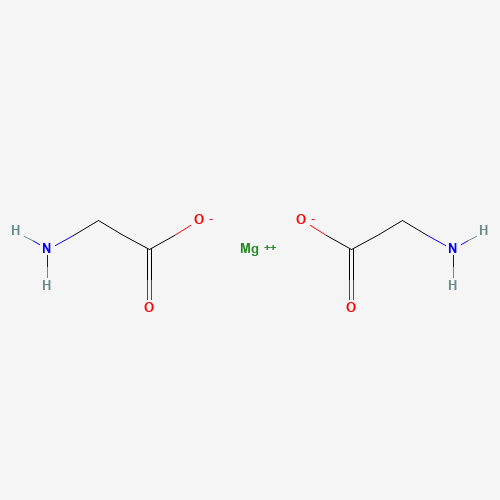
Magnesium glycinate/bisglycinate molecular structure
PubChem
01

Overview

Pure bisglycinate and buffered glycinate are different product identities: buffered material can contain magnesium oxide. Elemental magnesium, not total chelate mass, is the relevant mineral dose. [mgc-tga] [mgc-ods]

How it works

Elemental magnesium component

The mineral ion is the measured dose in clinical studies; the glycinate ligand changes compound mass and product composition. [2]

Glycine coingredient

Pure bisglycinate supplies glycine; the sleep trial did not separate magnesium from 1,523 mg/day glycine. [3]

Proposed amino-acid transport

Amino-acid or dipeptide transport is proposed as a formulation rationale, but no human trial established clinical superiority. [8]

Research mechanism

Source-specific mechanism detail is preserved in the cited source. [1]

Research mechanism

Source-specific mechanism detail is preserved in the cited source. [1]

Research mechanism

Source-specific mechanism detail is preserved in the cited source. [1]

Research mechanism

Source-specific mechanism detail is preserved in the cited source. [1]

Research mechanism

Source-specific mechanism detail is preserved in the cited source. [1]

02

Subjective effects

Reported experiences are kept separate from measured outcomes and remain tied to their cited context.

Increased
Human research

One four-week trial found a small improvement in self-reported insomnia severity; objective sleep was not measured and glycine was co-delivered. [3]

Population
Healthy adults reporting poor sleep
Exposure context
250 mg/day elemental magnesium bisglycinate plus 1,523 mg/day glycine
Increased
Human research

A short trial reported more 50-percent responders for cramp frequency and intensity with bisglycinate than placebo. [5]

Population
Pregnant women with frequent leg cramps
Exposure context
300 mg/day elemental magnesium bisglycinate
Variable
Human research

Source-specific effect evidence is preserved in the cited reference. [1]

Variable
Human research

Source-specific effect evidence is preserved in the cited reference. [1]

Variable
Human research

Source-specific effect evidence is preserved in the cited reference. [1]

Variable
Human research

Source-specific effect evidence is preserved in the cited reference. [1]

Variable
Human research

Source-specific effect evidence is preserved in the cited reference. [1]

03

Measured outcomes

What the research measured, for whom, and under which exposure. Findings remain attached to the study’s task or clinical endpoint.

Insomnia Severity Index improved modestly over four weeks; no objective sleep endpoint or glycine-only control was included. [3]

PopulationHealthy adults reporting poor sleepExposure250 mg/day elemental magnesium plus 1,523 mg/day glycineMeasureInsomnia Severity Index
Human research

Overall MoCA change was null; an exploratory subgroup over age 65 showed a signal that does not establish general cognitive enhancement. [4]

PopulationAdults in ancillary MoCA subsetExposurePersonalized magnesium glycinate supplementation for 12 weeksMeasureMontreal Cognitive Assessment
Human research

A 2026 abstract reported lower CRP and improved pulmonary measures in hypomagnesemic asthma/COPD adults; the dose was not clearly elemental. [6]

PopulationAdults with asthma or COPD and serum Mg <1.6 mg/dLExposureReported 440 mg/day magnesium glycinate for 12 monthsMeasureCRP and pulmonary function measures
Human research

Source-specific outcome evidence is preserved in the cited reference. [1]

PopulationNot establishedExposureNot establishedMeasureNot assessed
Human research

Source-specific outcome evidence is preserved in the cited reference. [1]

PopulationNot establishedExposureNot establishedMeasureNot assessed
Human research

Source-specific outcome evidence is preserved in the cited reference. [1]

PopulationNot establishedExposureNot establishedMeasureNot assessed
Human research

Source-specific outcome evidence is preserved in the cited reference. [1]

PopulationNot establishedExposureNot establishedMeasureNot assessed
Human research

Source-specific outcome evidence is preserved in the cited reference. [1]

PopulationNot establishedExposureNot establishedMeasureNot assessed
Human research
04

Doses & routes

Study doses and reference exposures, with route, formulation and duration.

Oral · By mouth · 5 records

Sleep RCT

Research exposure

250 mg/day [3]

Ingredient / form
Magnesium bisglycinate · 1,786 mg/day raw bisglycinate plus 1,523 mg/day glycine
Route
Oral
Frequency
Daily
Duration
4 weeks
Population
Healthy adults reporting poor sleep
Purpose
Research exposure

The co-delivered glycine prevents attribution to magnesium alone.

Cognition trial

Research exposure

216.5–389.55 mg/day [4]

Ingredient / form
Magnesium glycinate · Personalized study supplementation
Route
Oral
Frequency
Daily
Duration
12 weeks
Population
Adults in randomized parent trial; ancillary MoCA subset
Purpose
Research exposure

Reported range 77.25–389.55 mg/day; subgroup signal only.

Pregnancy leg-cramp RCT

Research exposure

300 mg/day [5]

Ingredient / form
Magnesium bisglycinate · Study capsules
Route
Oral
Frequency
Daily
Duration
4 weeks
Population
Pregnant women with frequent leg cramps
Purpose
Research exposure

Pregnancy-specific short trial.

Hypomagnesemia trial

Research exposure

440 mg/day magnesium glycinate; elemental status unspecified [6]

Ingredient / form
Magnesium glycinate · Study formulation not fully characterized in abstract
Route
Oral
Frequency
Daily
Duration
12 months
Population
Adults with serum Mg <1.6 mg/dL and asthma or COPD
Purpose
Research exposure

Do not treat 440 mg as elemental magnesium.

Reference upper limit

Reference description

350 mg/day [2]

Ingredient / form
Magnesium supplements · U.S. adult reference value
Route
Oral
Frequency
Daily
Duration
Reference threshold
Population
Adults
Purpose
Reference

Not a glycinate-specific efficacy dose.

05

Pharmacokinetics

Absorption, metabolism and elimination depend on the analyte, route, formulation, physiology and other exposures.

Timing explorer

Published timing evidence
The source reports timing terms but does not provide numeric elapsed intervals.
Peak
Short-term blood, urine and red-cell responses measured in comparative studies.
Duration
Sleep trial assessed four weeks; long-term duration not established.

Not established as a numeric timeline. Plasma timing and felt effects are distinct measurements. Source

Modeled elimination

The elimination model describes the named analyte after absorption and distribution. It does not establish felt-effect timing.

Oral · Pure or buffered bisglycinate; product-specific · not-established

Not modeled

Elimination model

An elimination model is not established for this observation.

Source-bound record

This observation provides context about the measured record, but it does not support a first-order elimination curve.

Measured analyte
Magnesium ion
Route
Oral
Formulation
Pure or buffered bisglycinate; product-specific
Population
Humans; short comparative studies

Source context

Human studies measured plasma, urine or red-cell magnesium after dosing; no analyte-specific terminal half-life for glycinate was established.
Read source context
Review the supporting record and source details.

Sourced elimination observations

Magnesium ion

No numeric estimate

Not established [7]

Route / formulation
Oral · Pure or buffered bisglycinate; product-specific
Population
Humans; short comparative studies

Human studies measured plasma, urine or red-cell magnesium after dosing; no analyte-specific terminal half-life for glycinate was established.

Parent compound or reported analyte

No numeric estimate

Not established [1]

Population
Humans

Source-specific pharmacokinetic detail is preserved in the cited source.

Parent compound or reported analyte

No numeric estimate

Not established [1]

Population
Humans

Source-specific pharmacokinetic detail is preserved in the cited source.

Parent compound or reported analyte

No numeric estimate

Not established [1]

Population
Humans

Source-specific pharmacokinetic detail is preserved in the cited source.

Parent compound or reported analyte

No numeric estimate

Not established [1]

Population
Humans

Source-specific pharmacokinetic detail is preserved in the cited source.

Parent compound or reported analyte

No numeric estimate

Not established [1]

Population
Humans

Source-specific pharmacokinetic detail is preserved in the cited source.

Bioavailability
Comparative red-cell response did not establish universal superiority over other forms. [7]
Metabolism / metabolites
Magnesium-ion handling is systemic and renal; glycinate-specific metabolism was not established. [7]

Factors that change the estimate

Baseline dietary magnesium

Possible larger exploratory sleep response at lower intake

Sleep trial exploratory effect modification; not a validated dosing rule. [3]

Related observation

Age

Exploratory cognition signal in participants older than 65

Overall MoCA result was null and subgroup analysis was ancillary. [4]

Related observation

Glycine co-exposure

Sleep attribution is confounded by co-delivered glycine

The sleep intervention supplied 1,523 mg/day glycine and had no glycine-only arm. [3]

Related observation

Product composition

Buffered products can add magnesium oxide

Pure and buffered products are different salt mixtures at the same labeled elemental amount. [9]

Related observation

Renal function

Reduced clearance increases accumulation risk

Magnesium-class safety risk rises with impaired renal function. [2]

Related observation

Modifier 1

Variable

Source-specific modifier evidence is preserved in the cited reference. [1]

Related observation

Modifier 2

Variable

Source-specific modifier evidence is preserved in the cited reference. [1]

Related observation

Modifier 3

Variable

Source-specific modifier evidence is preserved in the cited reference. [1]

Related observation

Modifier 4

Variable

Source-specific modifier evidence is preserved in the cited reference. [1]

Related observation

Modifier 5

Variable

Source-specific modifier evidence is preserved in the cited reference. [1]

Related observation

Modifier 6

Variable

Source-specific modifier evidence is preserved in the cited reference. [1]

Related observation
06

Safety & uncertainty

Adverse effects and interactions reported in the cited studies.

Warning

Renal impairment

Reduced kidney function increases magnesium accumulation risk; direct glycinate trials do not establish safety for advanced renal disease. [2]

Monitor

Gastrointestinal effects

Diarrhea, nausea and abdominal cramping are recognized magnesium-supplement effects; frequency is not established for every glycinate product. [2]

Context

Product identity

Buffered glycinate may contain magnesium oxide, so the salt mixture cannot be inferred from the word glycinate alone. [9]

Warning

Long-term uncertainty

The direct glycinate trials were short or disease-specific and do not establish long-term safety for healthy users. [3]

Monitor

Research caution

Source-specific caution detail is preserved in the cited source. [1]

Context

Research caution

Source-specific caution detail is preserved in the cited source. [1]

Warning

Research caution

Source-specific caution detail is preserved in the cited source. [1]

Monitor

Research caution

Source-specific caution detail is preserved in the cited source. [1]

Context

Research caution

Source-specific caution detail is preserved in the cited source. [1]

Warning

Research caution

Source-specific caution detail is preserved in the cited source. [2]

Interactions in cited sources

Explore a pair of substances

Oral bisphosphonates

Magnesium can reduce absorption of oral bisphosphonates; follow drug-label separation instructions. [2]

Context
Magnesium-class interaction, not a dedicated glycinate trial.

Tetracycline and quinolone antibiotics

Magnesium can reduce gastrointestinal absorption of susceptible antibiotics. [2]

Context
Magnesium-class interaction, not a dedicated glycinate trial.

Proton-pump inhibitors and diuretics

These drug classes can alter magnesium status and modify the context of supplementation. [2]

Context
Class-level magnesium balance interaction; no robust glycinate-specific DDI dataset.

Documented or hypothesized coexposure

Source-specific interaction detail is preserved in the cited source. [1]

Context
Evidence context preserved from Deep Research

Documented or hypothesized coexposure

Source-specific interaction detail is preserved in the cited source. [1]

Context
Evidence context preserved from Deep Research

Documented or hypothesized coexposure

Source-specific interaction detail is preserved in the cited source. [1]

Context
Evidence context preserved from Deep Research

Documented or hypothesized coexposure

Source-specific interaction detail is preserved in the cited source. [1]

Context
Evidence context preserved from Deep Research
07

Research & sources

14

Original publications, findings and available funding disclosures.

08

Connected claims

Explore the participants, roles and sources behind each relationship.

clinical-efficacyAuthored relationship

Magnesium glycinate improves sleep.

Sleepoutcome-domain

One short RCT found a small self-reported effect while co-delivering glycine.

Limitation No objective sleep measure or glycine-only arm.

clinical-efficacyAuthored relationship

Magnesium glycinate improves cognition.

Overall MoCA result was null; an older-subgroup signal was exploratory.

Limitation No replicated general cognitive benefit.

product-identityAuthored relationship

Buffered magnesium glycinate is pure bisglycinate.

Regulatory product records document added magnesium oxide in buffered material.

Limitation Product composition is formulation-specific.

evidence-boundaryAuthored relationship

magnesium glycinate improves sleep

Source-specific research report

Limitation Source-specific limitation preserved in the returned report.

evidence-boundaryAuthored relationship

magnesium glycinate improves cognition

Source-specific research report

Limitation Source-specific limitation preserved in the returned report.

evidence-boundaryAuthored relationship

magnesium glycinate corrects magnesium deficiency

Source-specific research report

Limitation 440 mg dose was not identified as elemental in the abstract

evidence-boundaryAuthored relationship

magnesium glycinate is better absorbed than other forms

Source-specific research report

Limitation Source-specific limitation preserved in the returned report.

evidence-boundaryAuthored relationship

magnesium glycinate is gentle on the stomach

Source-specific research report

Limitation not a universal head-to-head tolerance result

evidence-boundaryAuthored relationship

buffered magnesium glycinate is pure bisglycinate

Source-specific research report

Limitation Source-specific limitation preserved in the returned report.

Explore the relationship graph
10

Publication history

Content updated Oct 11, 2026.

Keep exploring

View graph