The substance library

Magnesium citrateA soluble magnesium salt with established short-term laxative labeling.

Also known as: magnesium citrate · trimagnesium dicitrate

Magnesium citrate is a magnesium–citrate salt; elemental magnesium is the relevant mineral quantity.
16 sourcesContent date Oct 11, 2026CompareExplore connectionsRevision history
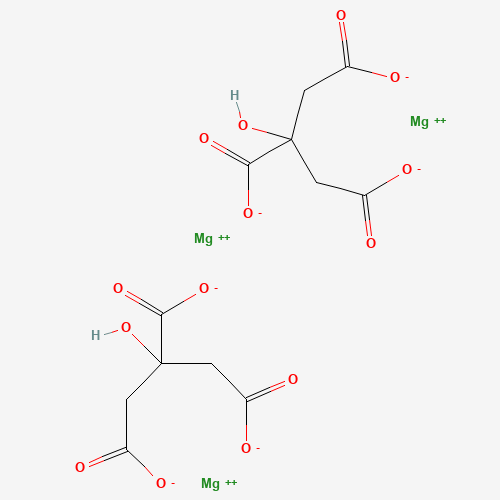
Magnesium citrate molecular structure
PubChem
01

Overview

The USP reference form is trimagnesium dicitrate. Product hydration, stoichiometry and assay change the conversion from salt mass to elemental magnesium; the cited OTC liquid separately declares both. [mc-usp] [mc-label]

How it works

Osmotic laxation

Magnesium citrate retains water in the gastrointestinal tract; increased luminal volume promotes bowel evacuation. [1]

Relative dissolution and absorption

Citrate was more soluble and produced higher urinary or serum magnesium responses than oxide in small comparative studies; the measurements are surrogates, not clinical outcomes. [4]

Magnesium-ion complexation

Divalent magnesium can reduce absorption of susceptible oral medicines by forming poorly absorbed complexes. [11]

Osmotic laxation

Magnesium citrate acts as an osmotic agent that retains water in the gastrointestinal tract; increased luminal volume promotes bowel evacuation. [11]

Solubility-related absorption

Relative to oxide, citrate remains more soluble across simulated gastric conditions, providing more dissolved magnesium for intestinal absorption. [14]

Active moiety

Chemical and pharmacokinetic interpretation indicates that absorbed magnesium is the relevant systemic mineral moiety, while citrate changes the salt's mass, solubility, and luminal osmotic contribution. [3]

Medication complexation

Divalent magnesium can form poorly absorbed complexes with susceptible oral medicines, including tetracyclines and fluoroquinolones. [11]

02

Subjective effects

Reported experiences are kept separate from measured outcomes and remain tied to their cited context.

Increased
Human research

Magnesium citrate retains water in the intestinal lumen and can soften stool or cause watery diarrhea at purgative exposure. [1]

Population
Adults and children using an OTC liquid
Exposure context
OTC saline-laxative exposure
Variable
Human research

PSQI improved in both treatment groups; the citrate-specific trial did not establish a magnesium-specific sleep effect. [6]

Population
Adults over 51 years with poor-quality sleep
Exposure context
320 mg magnesium/day as citrate for 7 weeks
Increased
Limited research

A 12-person open-label pilot reported lower symptom scores and improved quality of life, without a significant serum-magnesium change. [7]

Population
Adults with restless legs syndrome
Exposure context
200 mg magnesium citrate/day for 8 weeks
Variable
Human research

Retains water in the gastrointestinal tract, softens stool, increases bowel movements, and can produce watery diarrhea at purgative exposure. [11]

Variable
Human research

Can raise circulating Mg after oral dosing; citrate produced higher post-dose serum responses than oxide in one crossover study. [5]

Variable
Human research

In a placebo-controlled trial, PSQI improved from 10.4 to 6.6 overall, but improvement occurred regardless of citrate or sodium-citrate assignment. [6]

Variable
Human research

An open-label 12-person pilot using magnesium citrate reported lower symptom scores and improved quality-of-life scores, without a significant serum-Mg change. [7]

Variable
Human research

No citrate-specific cognitive enhancement effect is established by the cited evidence. [9]

03

Measured outcomes

What the research measured, for whom, and under which exposure. Findings remain attached to the study’s task or clinical endpoint.

The placebo-controlled trial improved PSQI overall, but the citrate-versus-placebo difference was not magnesium-specific. [6]

PopulationAdults over 51 years with poor-quality sleepExposure320 mg magnesium/day as citrate for 7 weeksMeasurePittsburgh Sleep Quality Index
Human research

The uncontrolled pilot reported lower symptom scores; placebo-controlled replication is absent. [7]

Population12 adults with restless legs syndromeExposure200 mg magnesium citrate/day for 8 weeksMeasureSymptom score and quality-of-life measures
Limited research

Source-specific outcome evidence is preserved in the cited reference. [11]

PopulationNot establishedExposureNot establishedMeasureNot assessed
Human research

Source-specific outcome evidence is preserved in the cited reference. [16]

PopulationNot establishedExposureNot establishedMeasureNot assessed
Human research

Source-specific outcome evidence is preserved in the cited reference. [6]

PopulationNot establishedExposureNot establishedMeasureNot assessed
Human research

Source-specific outcome evidence is preserved in the cited reference. [7]

PopulationNot establishedExposureNot establishedMeasureNot assessed
Human research

Source-specific outcome evidence is preserved in the cited reference. [9]

PopulationNot establishedExposureNot establishedMeasureNot assessed
Human research
04

Doses & routes

Study doses and reference exposures, with route, formulation and duration.

Oral · By mouth · 5 records

OTC saline laxative, adults and children ≥12 years

Approved-label context

6.5–10 fluid ounces [1]

Ingredient / form
Magnesium citrate · OTC liquid; 290 mg elemental Mg/fl oz on cited label
Route
Oral
Frequency
Single dose; maximum once daily
Duration
Short-term occasional constipation
Population
Adults and children ≥12 years
Purpose
Saline/osmotic laxation

Product label amount; 1.745 g magnesium citrate/fl oz is not 1.745 g elemental magnesium.

OTC saline laxative, children 6 to <12 years

Approved-label context

3–7 fluid ounces [1]

Ingredient / form
Magnesium citrate · OTC liquid
Route
Oral
Frequency
Single dose; maximum once daily
Duration
Children 6 to <12 years
Population
Children 6 to <12 years
Purpose
Saline/osmotic laxation

Product-specific label; not a universal pediatric regimen.

OTC saline laxative, children 2 to <6 years

Approved-label context

2–3 fluid ounces [1]

Ingredient / form
Magnesium citrate · OTC liquid
Route
Oral
Frequency
Single dose; maximum once daily
Duration
Children 2 to <6 years
Population
Children 2 to <6 years
Purpose
Saline/osmotic laxation

Product-specific label; not a universal pediatric regimen.

Poor-sleep trial

Research exposure

320 mg/day [6]

Ingredient / form
Magnesium citrate · Study preparation
Route
Oral
Frequency
Daily
Duration
7 weeks
Population
Adults >51 years with poor-quality sleep
Purpose
Research exposure

96 of 100 randomized participants completed the designed exposure; not a recommendation.

Restless-legs pilot

Research exposure

200 mg/day [7]

Ingredient / form
Magnesium citrate · Study preparation
Route
Oral
Frequency
Daily
Duration
8 weeks
Population
12 adults with restless legs syndrome
Purpose
Research exposure

Open-label uncontrolled pilot.

05

Pharmacokinetics

Absorption, metabolism and elimination depend on the analyte, route, formulation, physiology and other exposures.

Timing explorer

Published timing evidence
The source reports timing terms but does not provide numeric elapsed intervals.
Onset
Laxative onset approximately 0.5–6 hours for the cited OTC liquid.
Peak
Serum magnesium rose at several post-dose time points in one citrate-versus-oxide crossover study.
Duration
Laxation is formulation- and dose-dependent.

Not established as a numeric timeline. Plasma timing and felt effects are distinct measurements. Source

Modeled elimination

The elimination model describes the named analyte after absorption and distribution. It does not establish felt-effect timing.

Oral · Magnesium citrate formulations vary · not-established

Not modeled

Elimination model

An elimination model is not established for this observation.

Source-bound record

This observation provides context about the measured record, but it does not support a first-order elimination curve.

Measured analyte
Magnesium ion
Route
Oral
Formulation
Magnesium citrate formulations vary
Population
Humans; no citrate-specific analyte half-life study located

Source context

Citrate studies measured urinary or serum magnesium responses, not a validated plasma elimination half-life for the absorbed magnesium ion.
Read source context
Review the supporting record and source details.

Citrate-specific studies measured urinary or serum magnesium responses and do not establish a clinically useful human terminal half-life. [5]

Sourced elimination observations

Magnesium ion

No numeric estimate

Not established [5]

Route / formulation
Oral · Magnesium citrate formulations vary
Population
Humans; no citrate-specific analyte half-life study located

Citrate studies measured urinary or serum magnesium responses, not a validated plasma elimination half-life for the absorbed magnesium ion.

Parent compound or reported analyte

No numeric estimate

Not established [4]

Population
Humans

Source-specific pharmacokinetic detail is preserved in the cited source.

Parent compound or reported analyte

No numeric estimate

Not established [4]

Population
Humans

Source-specific pharmacokinetic detail is preserved in the cited source.

Parent compound or reported analyte

No numeric estimate

Not established [5]

Population
Humans

Source-specific pharmacokinetic detail is preserved in the cited source.

Parent compound or reported analyte

No numeric estimate

Not established [4]

Population
Humans

Source-specific pharmacokinetic detail is preserved in the cited source.

Parent compound or reported analyte

No numeric estimate

Not established [4]

Population
Humans

Source-specific pharmacokinetic detail is preserved in the cited source.

Parent compound or reported analyte

No numeric estimate

Not established [11]

Population
Humans

Source-specific pharmacokinetic detail is preserved in the cited source.

Bioavailability
Higher urinary and serum magnesium responses than oxide in small comparisons; not a universal absorption percentage. [5]
Metabolism / metabolites
Magnesium is handled through body pools and renal excretion; citrate-specific systemic metabolism was not established. [5]

Factors that change the estimate

Elemental-magnesium fraction

Variable by salt form and product

USP 3:2 chemistry and hydration/assay basis mean total compound mass is not elemental magnesium mass; label declarations control interpretation. [3]

Related observation

Baseline magnesium status

Response may differ

A subgroup with serum magnesium below 1.8 mg/dL showed a serum response in the sleep trial; the full cohort did not show a significant overall serum difference. [6]

Related observation

Renal function

Slower clearance increases risk

Reduced renal clearance and abnormal bowel states increase concern with high magnesium-citrate exposure. [10]

Related observation

Dose and intestinal retention

Higher laxative exposure changes gastrointestinal effect

Large purgative doses leave an osmotic load in the gut and differ pharmacologically from lower supplement exposures. [1]

Related observation

Modifier 1

3:2, dibasic, hydrated, and commercial preparations can differ in elemental-Mg fraction; label declarations supersede generic arithmetic.

Source-specific modifier evidence is preserved in the cited reference. [11]

Related observation

Modifier 2

In the citrate sleep trial, the subgroup with serum Mg below 1.8 mg/dL showed a serum-Mg response; the full cohort did not show a significant serum-Mg difference versus placebo.

Source-specific modifier evidence is preserved in the cited reference. [6]

Related observation

Modifier 3

The 2017 citrate-versus-oxide crossover study used a five-day magnesium-saturation phase, which affects interpretation of urinary-excretion endpoints.

Source-specific modifier evidence is preserved in the cited reference. [5]

Related observation

Modifier 4

Large laxative doses leave a substantial osmotic load in the gut and are pharmacologically different from lower supplement exposures.

Source-specific modifier evidence is preserved in the cited reference. [11]

Related observation

Modifier 5

Reduced renal clearance and obstructive or abnormal bowel states increase the safety concern associated with magnesium-citrate exposure.

Source-specific modifier evidence is preserved in the cited reference. [11]

Related observation

Modifier 6

The OTC label specifies an 8-ounce liquid with each dose and warns that laxatives can alter how other drugs work.

Source-specific modifier evidence is preserved in the cited reference. [11]

Related observation
06

Safety & uncertainty

Adverse effects and interactions reported in the cited studies.

Warning

Renal impairment

Magnesium-containing bowel preparations should be avoided or used only with professional review in renal insufficiency or failure because magnesium is renally cleared. [10]

Monitor

Hypermagnesemia and fluid loss

High or repeated laxative exposures can cause diarrhea, dehydration, electrolyte disturbance and hypermagnesemia, with greater risk when renal clearance is reduced. [1]

Context

Gastrointestinal red flags

The cited label flags abdominal pain, nausea, vomiting, persistent bowel-habit change, rectal bleeding and failure to have a bowel movement after use. [1]

Warning

Short-term labeled use

The cited OTC label limits unsupervised laxative use to no longer than one week. [1]

Monitor

Research caution

Source-specific caution detail is preserved in the cited source. [11]

Context

Research caution

Source-specific caution detail is preserved in the cited source. [11]

Warning

Research caution

Source-specific caution detail is preserved in the cited source. [11]

Monitor

Research caution

Source-specific caution detail is preserved in the cited source. [11]

Context

Research caution

Source-specific caution detail is preserved in the cited source. [11]

Warning

Research caution

Source-specific caution detail is preserved in the cited source. [11]

Interactions in cited sources

Explore a pair of substances

Ciprofloxacin

Magnesium-containing products can reduce ciprofloxacin absorption; the cited label requires separation. [11]

Context
Documented class interaction from ciprofloxacin labeling; not a citrate-specific trial.

Doxycycline and tetracyclines

Magnesium-containing antacids impair tetracycline absorption; follow the drug label separation instructions. [12]

Context
Documented class interaction; citrate-specific product testing was not required.

Oral bisphosphonates

Magnesium coadministration can disrupt the labeled alendronate administration sequence and may reduce absorption. [13]

Context
Timing inference from the drug label, not a citrate-specific interaction trial.

Documented or hypothesized coexposure

Source-specific interaction detail is preserved in the cited source. [11]

Context
Evidence context preserved from Deep Research

Documented or hypothesized coexposure

Source-specific interaction detail is preserved in the cited source. [11]

Context
Evidence context preserved from Deep Research

Documented or hypothesized coexposure

Source-specific interaction detail is preserved in the cited source. [12]

Context
Evidence context preserved from Deep Research

Documented or hypothesized coexposure

Source-specific interaction detail is preserved in the cited source. [11]

Context
Evidence context preserved from Deep Research

Documented or hypothesized coexposure

Source-specific interaction detail is preserved in the cited source. [13]

Context
Evidence context preserved from Deep Research
07

Research & sources

16

Original publications, findings and available funding disclosures.

08

Connected claims

Explore the participants, roles and sources behind each relationship.

relative-bioavailabilityAuthored relationship

Magnesium citrate produces higher absorption surrogates than magnesium oxide in small comparative studies.

Magnesium homeostasismeasured-mineral-system

Healthy-volunteer urinary and serum endpoints; this does not establish superior clinical outcomes.

Limitation Indirect surrogate outcomes and small samples do not establish a universal absorption ranking.

clinical-efficacyAuthored relationship

Magnesium citrate is a reliable sleep aid.

Magnesium citrateintervention
Sleepoutcome-domain

Citrate-specific placebo-controlled evidence.

Limitation Overall sleep improvement was not magnesium-specific and mixed-form reviews remain inconsistent.

dose-interpretationAuthored relationship

The mass of magnesium citrate equals the mass of elemental Mg.

Elemental magnesium is only a fraction of the salt mass.

Limitation Hydration and product assay can change the exact fraction.

evidence-boundaryAuthored relationship

Magnesium citrate is more bioavailable than magnesium oxide.

Magnesium citrateintervention
Cognitive test performancereported-outcome-context

Source-specific research report

Limitation Source-specific limitation preserved in the returned report.

evidence-boundaryAuthored relationship

Magnesium citrate is a reliable sleep aid.

Magnesium citrateintervention
Cognitive test performancereported-outcome-context

Source-specific research report

Limitation Source-specific limitation preserved in the returned report.

evidence-boundaryAuthored relationship

Magnesium citrate improves cognition or memory.

Magnesium citrateintervention
Cognitive test performancereported-outcome-context

Source-specific research report

Limitation Source-specific limitation preserved in the returned report.

evidence-boundaryAuthored relationship

Magnesium citrate is non-laxative when used as a supplement.

Magnesium citrateintervention
Cognitive test performancereported-outcome-context

Source-specific research report

Limitation Source-specific limitation preserved in the returned report.

evidence-boundaryAuthored relationship

A stated mass of magnesium citrate equals the same mass of elemental Mg.

Magnesium citrateintervention
Cognitive test performancereported-outcome-context

Source-specific research report

Limitation Source-specific limitation preserved in the returned report.

Explore the relationship graph
10

Publication history

Content updated Oct 11, 2026.

Keep exploring

View graph