Press Ctrl+S to jump to search, or / to focus search
The substance library
DMTShort-acting tryptamine psychedelic with rapid intravenous pharmacokinetics.
Also known as: N,N-Dimethyltryptamine · Dimethyltryptamine
DMT is a tryptamine psychedelic with rapid onset and short duration when given intravenously. Human studies examine perception, consciousness and pharmacokinetics.
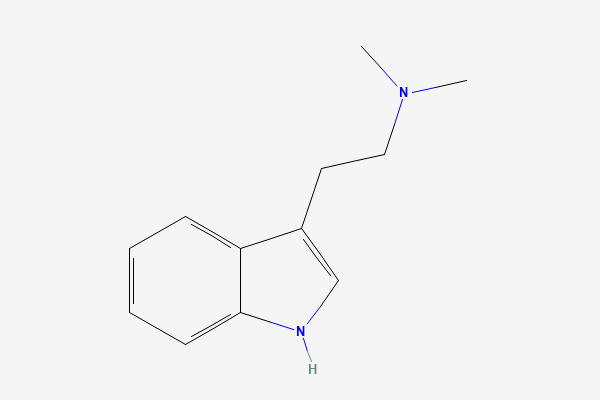
DMT is N,N-dimethyltryptamine, PubChem CID 6089, molecular formula C12H16N2 and molecular weight 188.27 g/mol. This article concerns DMT itself and prioritizes controlled human IV bolus and infusion data. Source: pubchem6089.
Classic human dose-response work found an almost immediate subjective response after IV administration, with higher doses producing vivid visual phenomena, profound changes in bodily awareness and sense of self, euphoria in some sessions, and anxiety or loss of control in others. Contemporary studies reproduce the steep, rapid dose-response while showing that slower or participant-adjustable infusion can soften the transition into the psychedelic state. Sources: strassman1994-subjective, james2024-phase1, erne2025-continuous, erne2026-bolus.
The acute physiological state is not purely subjective. Human studies have measured transient increases in blood pressure, autonomic changes, pupil dilation, altered sustained attention and postural stability, and suppression of occipital alpha EEG power at sufficient exposure. These outcomes need to be distinguished from subjective intensity and from pharmacokinetics: plasma DMT can have a single-digit-minute elimination half-life even though conscious effects persist longer, while continuous drug delivery can maintain effects despite rapid clearance. Sources: strassman1994-autonomic, james2024-phase1, vanderheijden2025-sixhour, erne2026-bolus.
How it works
Rapid MAO-A-mediated metabolism
Human pharmacokinetic and in-vitro experiments support rapid oxidative metabolism of DMT through MAO-A, with indole-3-acetic acid as an important downstream metabolite. Inhibition of MAO-A markedly reduced DMT clearance in experimental systems; CYP2D6 and CYP2C19 also metabolized DMT in vitro but are unlikely to explain the exceptionally high systemic clearance of IV DMT by themselves. [4]
Human neuroimaging analyses have related regional DMT-induced functional-connectivity changes to independently acquired PET maps of neurotransmitter receptors and transporters, including serotonin-receptor distributions. This provides spatial association evidence, not direct measurement of DMT receptor occupancy in the participants receiving DMT. [12]
A time-dependent whole-brain model fitted to fMRI data from 15 volunteers given 20 mg IV DMT found transient increases in modeled brain reactivity concentrated in frontoparietal and visual regions and correlated with 5-HT2A receptor-density maps. The receptor link is correlational/model-based and should not be read as a direct PET occupancy result. [13]
5-HT1A modulation of the DMT experience
In 12 experienced participants, pretreatment with 30 mg oral pindolol before 0.1 mg/kg IV DMT increased Hallucinogen Rating Scale effects and increased blood pressure and mean arterial pressure at 2 min without significantly changing heart rate. This suggests that 5-HT1A signaling modulates, rather than simply generates, the human DMT subjective response. [11]
02
Subjective effects
Reported experiences are kept separate from measured outcomes and remain tied to their cited context.
03
Measured outcomes
What the research measured, for whom, and under which exposure. Findings remain attached to the study’s task or clinical endpoint.
Systolic and diastolic blood pressure increased transiently after active SPL026. At 21.5 mg, mean systolic pressure rose from 120.33 to 149.67 mmHg and mean diastolic pressure from 71.00 to 86.00 mmHg at the 12-min assessment; the elevations were not sustained at 1 h. [5]
At the higher prolonged DMT exposures, adaptive-tracking performance decreased, indicating impaired sustained attention while drug exposure was maintained. [7]
PopulationHealthy adultsExposureBolus plus 6-h infusion, with the highest regimen reaching mean peak plasma concentrations of about 36 ng/mLMeasureNeuroCart adaptive tracking
A single 21.5 mg IV DMT session delivered with psychotherapeutic support produced a larger 2-week reduction in MADRS score than placebo. Longer-term observations extending to 3 months included open-label treatment and therefore provide weaker causal evidence than the blinded 2-week comparison. [6]
Population34 adults with moderate-to-severe major depressive disorderExposure21.5 mg IV DMT over 10 min with psychotherapeutic supportMeasureMontgomery-Åsberg Depression Rating Scale
The healthy-volunteer phase I study found no evidence of an SPL026-related improvement or worsening in trait-anxiety scores versus placebo across follow-up. This null finding occurred in a small, psychologically screened sample with high baseline wellbeing. [5]
Serum and plasma BDNF did not significantly change relative to placebo across the studied prolonged DMT exposures. The investigators cautioned that peripheral BDNF is an uncertain proxy for central neuroplasticity, so this null result does not establish absence of neural plasticity. [7]
PopulationHealthy adultsExposureBolus plus 6-h DMT infusionMeasureSerum and plasma BDNF assays
Human research
Study-result plots
5 of 6 findings in this selection lack structured estimates. Different measures, populations, instruments, comparators, or assessment times are shown separately.
04
Doses & routes
Study doses and reference exposures, with route, formulation and duration.
Intravenous · Into a vein · 8 records
05
Pharmacokinetics
Absorption, metabolism and elimination depend on the analyte, route, formulation, physiology and other exposures.
Timing explorer
Modeled elimination
The elimination model describes the named analyte after absorption and distribution. It does not establish felt-effect timing.
Mean elimination half-life in psychedelic-naïve healthy adults receiving 9–21.5 mg DMT free-base equivalent as two-phase 10-min intravenous infusions. A separate 2026 bolus study reported an approximately 6–7 min elimination half-life, indicating protocol-dependent estimates rather than one universal value. [4]
Sourced elimination observations
Bioavailability
The human evidence emphasized here uses intravenous DMT. DMT without monoamine-oxidase inhibition has poor oral availability because of rapid metabolism; ayahuasca or pharmaceutical DMT-plus-MAO-inhibitor regimens are pharmacologically different interventions. [4]
Metabolism / metabolites
DMT is rapidly cleared, with human in-vitro and clinical evidence supporting a major role for MAO-A and rapid formation of indole-3-acetic acid. CYP2D6 and, to a lesser extent, CYP2C19 metabolized DMT in vitro where MAO-A activity was sparse. [4]
Factors that change the estimate
06
Safety & uncertainty
Adverse effects and interactions reported in the cited studies.
Warning
Acute cardiovascular load
Controlled IV DMT can transiently increase blood pressure, and classic bolus work also found dose-related autonomic and cardiovascular activation. Modern trials generally screened out clinically important baseline cardiovascular abnormalities. The available healthy-volunteer safety findings therefore should not be generalized to uncontrolled use or to people with significant cardiovascular disease. [5]
Monitor
Anxiety, panic, and prolonged psychological reactions
Most adverse events in modern supervised studies were mild or moderate, but clinically important anxiety can occur. In the 6-h study one participant required counseling after a moderate anxiety event and the report described a prolonged anxiety course; the 2026 bolus program also described a participant who developed post-session anxiety/panic requiring subsequent care. Small screened trials cannot quantify the population incidence of rare or persistent psychiatric adverse reactions. [7]
Context
Psychiatric screening limits generalizability
Several healthy-volunteer programs excluded current or past psychiatric disorders, suicidality, or close family history of psychotic or bipolar disorders. These exclusions reduce direct evidence for safety in people at elevated risk of mania or psychosis. The separate MDD trial establishes that depression itself is not universally excluded, but it used clinical screening and supervised psychological support. [4]
Warning
Pregnancy and lactation evidence gap
Pregnancy and lactation were exclusion criteria in the SPL026 clinical program. The trial therefore does not establish pregnancy safety, and absence of pregnancy participants must not be interpreted as evidence of safety or evidence of teratogenic harm. [14]
Monitor
Monoamine-oxidase inhibition can fundamentally alter DMT exposure
DMT is rapidly metabolized by MAO-A. Combining DMT with MAO-A inhibition, as occurs pharmacologically in ayahuasca-type preparations or synthetic DMT-plus-MAO-inhibitor regimens, changes bioavailability and duration and should not be treated as equivalent to DMT monotherapy. The IV DMT studies summarized here generally do not establish the safety of combining their regimens with MAO inhibitors. [4]
Context
Evidence comes from controlled settings
Preparation, close observation, trained staff, controlled rooms, and in some protocols continuous cardiovascular or neurophysiological assessment were integral to the research context. Safety findings from those environments do not establish equivalent risk under unsupervised conditions. [4]
Original publications, findings and available funding disclosures.
Reports elsewhere
This link leaves BHWiki for an outside experience index. It is not a finding, a dose, or a source for the claims above. The report text is not stored here.
Explore the participants, roles and sources behind each relationship.
may-reduceAuthored relationship
A single 21.5 mg IV DMT session with psychotherapeutic support can reduce depressive symptom severity more than placebo at 2 weeks in adults with moderate-to-severe major depressive disorder.
One phase IIa randomized placebo-controlled trial with 34 participants; the sponsor was Small Pharma and the intervention included psychotherapeutic support.
Limitation Small phase IIa sample, substantial contextual support, and difficult psychedelic blinding limit precision and attribution. The longer 3-month observations followed an open-label treatment phase and are weaker evidence for sustained placebo-controlled efficacy.
evidence-gapAuthored relationship
Direct human PET measurement of DMT 5-HT2A receptor occupancy is not established by the human evidence reviewed for this article.
Available reviewed human neuroimaging evidence related DMT-induced fMRI changes to receptor-density PET atlases obtained independently rather than performing a DMT occupancy PET experiment in the dosed participants.
Limitation This is a literature-search conclusion, not proof of absence; a study outside the reviewed evidence set could exist.
protocol-dependentAuthored relationship
Acute tolerance to DMT depends on administration pattern rather than being a uniform property of the drug.
Continuous 120-min infusion produced moderate attenuation of some acute effects, whereas the 2026 repeated-bolus study reported no acute tolerance.
Limitation The studies used different designs, exposure patterns, timing, and participants, so the contrast is cross-study and does not isolate infusion pattern experimentally.
may-modify-exposureAuthored relationship
Cigarette-smoking status may be an important source of DMT pharmacokinetic variability during IV infusion.
A 2026 study reported approximately twofold higher DMT plasma concentrations in smokers than non-smokers at similar infusion rates.
Limitation Smoking was not randomly assigned; the proposed role of MAO-A-inhibiting smoke constituents is mechanistic interpretation rather than a directly isolated causal test.