Adult ADHD symptom severity
VariableSource-specific outcome evidence is preserved in the cited reference. [2]
Human research
The substance library
Also known as: Vyvanse
Lisdexamfetamine is a prodrug converted to dextroamphetamine. It is studied for attention and other effects of catecholamine signalling.
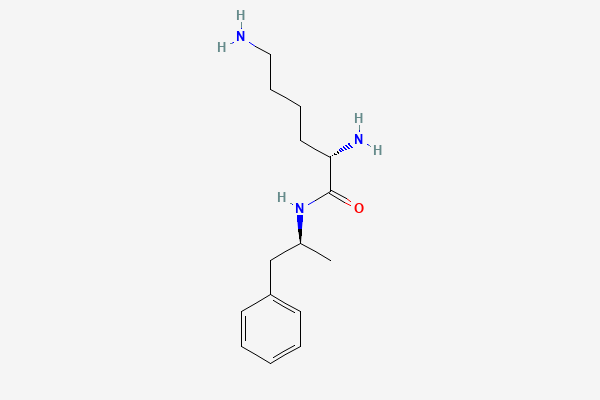
Lisdexamfetamine is an identity record for PubChem CID 11597698 (C15H25N3O). The structure and molecular weight come from that compound record. Salts, stereoisomers, preparations, and commercial products can differ. It is indexed under Stimulant, Phenethylamine. Effects, doses, pharmacokinetics, interactions, and legal status have not been assessed for this draft.
Vyvanse is available as oral capsules and chewable tablets. The pharmacological activity is predominantly attributable to the released dextroamphetamine, which enhances catecholaminergic neurotransmission. The conversion step contributes to a comparatively gradual active-drug concentration profile after oral administration; this does not confer immunity from misuse or make the drug nonaddictive. [sourceId: fda2025]
Red-blood-cell-associated conversion releases active dextroamphetamine and L-lysine [2]
Released dextroamphetamine promotes central dopaminergic and noradrenergic signaling through amphetamine-associated monoamine transporter and presynaptic mechanisms [2]
Conversion following absorption contributes to a delayed dextroamphetamine peak relative to the prodrug [2]
Central catecholaminergic effects plausibly influence impulse control and food-related behavior [2]
Reported experiences are kept separate from measured outcomes and remain tied to their cited context.
What the research measured, for whom, and under which exposure. Findings remain attached to the study’s task or clinical endpoint.
Source-specific outcome evidence is preserved in the cited reference. [2]
Source-specific outcome evidence is preserved in the cited reference. [2]
Source-specific outcome evidence is preserved in the cited reference. [2]
Source-specific outcome evidence is preserved in the cited reference. [2]
Source-specific outcome evidence is preserved in the cited reference. [2]
Source-specific outcome evidence is preserved in the cited reference. [2]
Source-specific outcome evidence is preserved in the cited reference. [2]
Source-specific outcome evidence is preserved in the cited reference. [2]
Study doses and reference exposures, with route, formulation and duration.
Other routes · Other or unspecified · 5 records
Absorption, metabolism and elimination depend on the analyte, route, formulation, physiology and other exposures.
The elimination model describes the named analyte after absorption and distribution. It does not establish felt-effect timing.
not-established
Elimination model
This observation provides context about the measured record, but it does not support a first-order elimination curve.
Adverse effects and interactions reported in the cited studies.
Source-specific evidence is preserved in the cited source. [2]
Source-specific evidence is preserved in the cited source. [2]
Source-specific evidence is preserved in the cited source. [2]
Source-specific evidence is preserved in the cited source. [2]
Source-specific evidence is preserved in the cited source. [2]
Source-specific evidence is preserved in the cited source. [2]
Source-specific evidence is preserved in the cited source. [2]
Source-specific evidence is preserved in the cited source. [2]
Source-specific evidence is preserved in the cited source. [2]
Source-specific evidence is preserved in the cited source. [2]
Original publications, findings and available funding disclosures.
This link leaves BHWiki for an outside experience index. It is not a finding, a dose, or a source for the claims above. The report text is not stored here.
Content updated Oct 3, 2026.