Warning
Higher dose, more anxiety
In the 16-person dose-effect study, 200 µg produced more ego dissolution and significant anxiety than the lower doses. [2]
The substance library
Also known as: Lysergic acid diethylamide · (+)-LSD
Lysergic acid diethylamide, recorded here as the (+)-isomer, PubChem CID 5761. A human pharmacokinetic study reports a geometric mean plasma half-life of 2.6 hours after 100 and 200 µg orally.
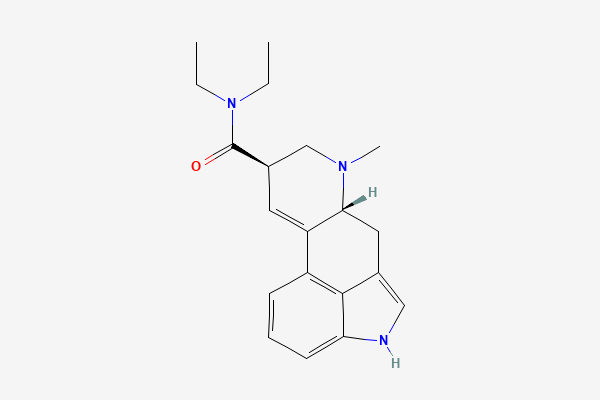
This article is the parent compound PubChem titles (+)-lysergic acid diethylamide. A pharmacokinetic study measured plasma concentrations and subjective timing after 100 and 200 µg. A separate study in 16 healthy adults described dose-dependent subjective effects from 25 to 200 µg. A review describes psychedelics as agonists or partial agonists at brain 5-HT2A receptors and names LSD in that class history. Legal status was not assessed: a DEA fact sheet for LSD was not retrieved.
Nichols describes psychedelics as agonists or partial agonists at brain 5-HT2A receptors. LSD is named in that historical class framing. [3]
Reported experiences are kept separate from measured outcomes and remain tied to their cited context.
Study doses and reference exposures, with route, formulation and duration.
Oral · By mouth · 2 records
Absorption, metabolism and elimination depend on the analyte, route, formulation, physiology and other exposures.
The elimination model describes the named analyte after absorption and distribution. It does not establish felt-effect timing.
Oral · Oral study LSD · study-mean
Geometric mean plasma half-life 2.6 hours (95% CI 2.2–3.4) after oral 100 and 200 µg in the cited pharmacokinetic study. The interval is a confidence interval for that mean. [1]
Adverse effects and interactions reported in the cited studies.
In the 16-person dose-effect study, 200 µg produced more ego dissolution and significant anxiety than the lower doses. [2]
Original publications, findings and available funding disclosures.
This link leaves BHWiki for an outside experience index. It is not a finding, a dose, or a source for the claims above. The report text is not stored here.
Explore the participants, roles and sources behind each relationship.
Class review, not an LSD receptor-binding experiment
Limitation The statement is class consensus in a review. It is not an LSD binding constant, and a ketanserin outcome from a separate study was not included here.
Content updated Oct 3, 2026.