Adjustment-disorder symptoms
VariableThe 2025 Latvian before/after cohort reported lower ADNM-20 scores, but no untreated or placebo comparator was present. [6]
Human research
The substance library
Also known as: β-phenyl-GABA · Noofen · Noophen · Anvifen · Фенибут
Phenibut is a synthetic GABA analogue with prescription use in some post-Soviet settings and substantial nonmedical online exposure. WHO and the systematic-review evidence do not establish moderate- or high-certainty efficacy; toxicity, dependence and withdrawal signals are better documented than healthy-person benefit. [dr-phenibut-s1][kupats2020]
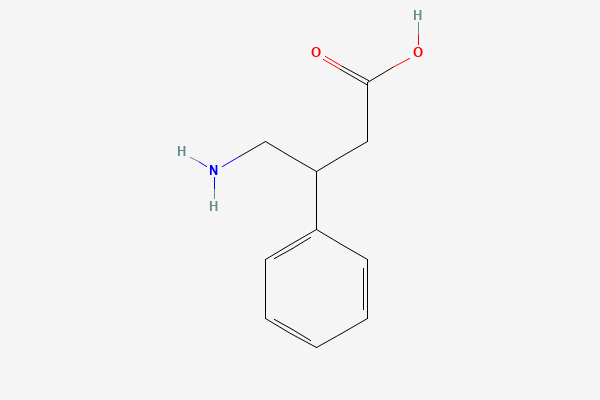
Clinical studies concern adjustment disorder, headache, facial pain, ADHD, vascular disease and fatigue rather than healthy enhancement. Product salt, formulation and dose accuracy vary across Noofen prescriptions and online phenibut products. [dr-phenibut-s2][dr-phenibut-s7]
WHO supports GABA_B and α2δ-related pharmacology mainly from nonhuman or in-vitro evidence; the often-repeated GABA_A claim was not adequately substantiated. [1]
Experiments reported in this study have been performed in order to investigate cholinergic and GABA-ergic neurotransmitter systems and substance P in the realization of internal inhibition and pain reinforcement. [18]
Phenibut is a γ-aminobutyric acid (GABA) agonist designed and used as an anxiolytic in Russia. [19]
Reported experiences are kept separate from measured outcomes and remain tied to their cited context.
What the research measured, for whom, and under which exposure. Findings remain attached to the study’s task or clinical endpoint.
The 2025 Latvian before/after cohort reported lower ADNM-20 scores, but no untreated or placebo comparator was present. [6]
U.S. poison-center surveillance identified major effects and deaths, but passive records include coexposures and do not establish incidence among users. [13]
While phenibut was helpful initially, the patient developed dependence including tolerance, significant withdrawal symptoms within 3-4 h of last use and failure to fulfil his roles at work and at home. [19]
Study doses and reference exposures, with route, formulation and duration.
Oral · By mouth · 4 records
Absorption, metabolism and elimination depend on the analyte, route, formulation, physiology and other exposures.
The elimination model describes the named analyte after absorption and distribution. It does not establish felt-effect timing.
Oral · Salt/formulation not consistently specified · not-established
Elimination model
This observation provides context about the measured record, but it does not support a first-order elimination curve.
Source context
WHO could not independently verify commonly repeated 5.3-hour half-life and 65% unchanged urinary-excretion claims; no eligible modern primary PK study established bioavailability, Tmax or concentration-response.Read source context
Legacy half-life claims are not independently verifiable in the eligible primary human record. [1]
Adverse effects and interactions reported in the cited studies.
Published withdrawal cases include seizures, intubation and ICU admission; all were case-based and publication-selected, so percentages describe the case series rather than average-user risk. [12]
Poison-center and toxicity reviews document somnolence, psychosis, altered mental status, coma and airway intervention, with common coexposures. [11]
No adequate human pregnancy, lactation, renal-impairment or hepatic-impairment studies were identified. [1]
We present a case of a patient who used phenibut to self-medicate anxiety, insomnia and cravings for alcohol. [19]
Original publications, findings and available funding disclosures.
This link leaves BHWiki for an outside experience index. It is not a finding, a dose, or a source for the claims above. The report text is not stored here.
Explore the participants, roles and sources behind each relationship.
Eligible human studies are clinical-population studies with weak or unclear methods; no adequate healthy-volunteer efficacy trial was found.
Limitation Marketing language cannot substitute for randomized evidence.
Published toxicity and withdrawal reports include severe CNS depression, seizures, intubation and ICU care.
Limitation Case-series selection prevents a population incidence estimate, but benignity is not supported.
Source-specific result from PMID 23391959; applies to the population and design described in that abstract.
Limitation Abstract result from PMID 23391959; this single study does not establish general efficacy or safety.
Source-specific result from PMID 23391959; applies to the population and design described in that abstract.
Limitation Abstract result from PMID 23391959; this single study does not establish general efficacy or safety.
Source-specific result from PMID 20841974; applies to the population and design described in that abstract.
Limitation Abstract result from PMID 20841974; this single study does not establish general efficacy or safety.
Source-specific result from PMID 20841974; applies to the population and design described in that abstract.
Limitation Abstract result from PMID 20841974; this single study does not establish general efficacy or safety.
Source-specific result from PMID 23717928; applies to the population and design described in that abstract.
Limitation Abstract result from PMID 23717928; this single study does not establish general efficacy or safety.
Source-specific result from PMID 23717928; applies to the population and design described in that abstract.
Limitation Abstract result from PMID 23717928; this single study does not establish general efficacy or safety.
Content updated Oct 11, 2026.