 Wikipedia
 Examine
Cold-stress processing speed
IncreasedTwo 150 mg/kg exposures improved selected match-to-sample accuracy and processing-speed measures during repeated cold-water immersion. [5]
Human research
The substance library
Also known as: L-tyrosine · free L-tyrosine
Acute free L-tyrosine has the clearest human signal when cold exposure, prolonged wakefulness, or another demand challenges catecholamine function.
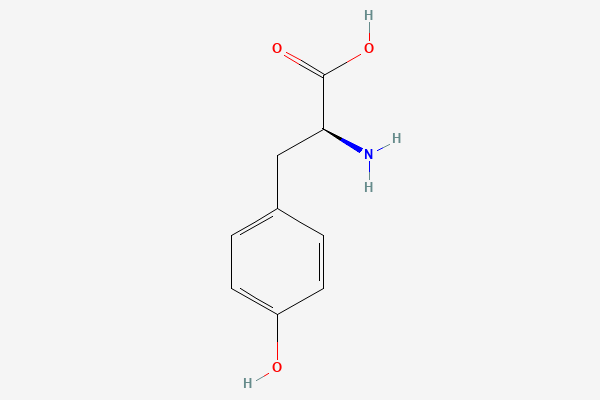
Tyrosine is an amino-acid precursor used in protein synthesis and in pathways leading to L-DOPA, dopamine, norepinephrine, epinephrine, thyroid hormones, and melanin. Most cognition trials used free L-tyrosine as an acute oral load; NALT evidence is pharmacokinetic and intravenous, so its findings should not be relabeled as free L-tyrosine efficacy. [tyrosine-r13] [tyrosine-r14] [tyrosine-r17]
Free L-tyrosine supplies substrate for tyrosine hydroxylase and downstream L-DOPA, dopamine, and norepinephrine synthesis. This is a biochemical pathway, not proof of a uniform brain dopamine increase. [15]
Cold exposure, prolonged wakefulness, and heavy cognitive demand may increase catecholamine requirements; raising circulating tyrosine may help preserve selected task performance when synthesis or release is challenged. [2]
Plasma tyrosine competes with other large neutral amino acids relevant to brain transport. Oral tyrosine can raise the tyrosine-to-competitor ratio, but the size of central exposure and functional effect varies with diet and state. [13]
Human cognition trials measured performance and peripheral biomarkers rather than central catecholamines. NALT showed substantial unchanged urinary excretion during intravenous infusion, so it cannot be assumed to reproduce free L-tyrosine exposure or effects. [14]
Tyrosine administration elevates striatal levels of dopamine metabolites in animals given treatments that accelerate nigrostriatal firing, but not in untreated rats. [20]
l-Tyrosine (TYR), the precursor of dopamine (DA), has been shown to enhance facets of cognitive control in situations with high cognitive demands. [21]
In this study, we investigated whether creativity in convergent- and divergent-thinking tasks is promoted by the food supplement L-Tyrosine (TYR)-a biochemical precursor of dopamine, which is assumed to drive cognitive control and creativity. [22]
Tyrosine (TYR), an amino acid found in various foods, has been shown to increase dopamine (DA) levels in the brain. [24]
It is speculated dopamine (DA) might play an important role in this inconsistency, by determining the direction and strength of the cognitive-behavioral effects of tDCS. [28]
Dopamine (DA) neurotransmission is critical for motivational processing. [31]
The article describes tyrosine as a precursor that can raise dopamine availability and proposes that baseline dopamine function, COMT/DRD2/DAT1 variation, and task demand may moderate cognitive effects; these are mechanistic hypotheses summarized from prior literature, not new causal measurements in this paper. [29]
What the research measured, for whom, and under which exposure. Findings remain attached to the study’s task or clinical endpoint.
Two 150 mg/kg exposures improved selected match-to-sample accuracy and processing-speed measures during repeated cold-water immersion. [5]
A split 150 mg/kg exposure reduced deterioration in psychomotor performance and high-event-rate vigilance for roughly three hours. [6]
Tyrosine improved several running-memory, reasoning, mathematical-processing, tracking, and vigilance measures, but not every task and less broadly than d-amphetamine. [7]
Tyrosine did not change sleep quantity, sleep quality, or recovery-sleep architecture, although it stimulated prolactin release. [8]
Serum tyrosine rose substantially, but cognition, physiology, and time-trial performance did not improve in the military heat-exercise crossover. [9]
A 2 g dose worsened Wisconsin Card Sorting Test flexibility after high cognitive load rather than preventing impairment. [10]
The thermoneutral control condition was null, and reviews do not support a consistent generalized enhancement effect in rested healthy adults. [3]
l-Tyrosine (TYR), the precursor of dopamine (DA), has been shown to enhance facets of cognitive control in situations with high cognitive demands. However some previous outcomes were mixed: some studies reported significant improvements, while other did not. Given that TYR increases DA level in the brain, we investigated, in a double-blind, randomized, placebo-controlled design, whether the C957T genotypes of a functional synonymous polymorphism in the human dopamine D2 receptor (DRD2) gene (rs6277) contribute to individual differences in the reactivity to TYR administration and whether this factor predicts the magnitude of TYR-induced performance differences on inhibiting behavioral responses in a stop-signal task and working memory (WM) updating in a N-back task. [21]
Tyrosine (TYR), an amino acid found in various foods, has been shown to increase dopamine (DA) levels in the brain. Recent studies have provided evidence that TYR supplementation can improve facets of cognitive control in situations with high cognitive demands. reduced switching costs). [24]
Previous studies indicate that tyrosine may prove useful in promoting improved performance in situations in which performance is compromised by stress. Administration of tyrosine significantly enhanced accuracy and decreased frequency of list retrieval on the working memory task during the multiple task battery compared with placebo. However, tyrosine induced no significant changes in performance on the arithmetic, visual, or auditory tasks during the Multiple Task, or modified any performance measures during the Simple Task battery. [26]
Experiment 1 showed Tyr administration enhances performance in a verbal N-back task. Experiment 2 showed Tyr modulates the effect of bilateral tDCS over DLPFC on WM. Specifically, tDCS had opposite effects on performance depending on current direction through the brain and Tyr administration. The present study provides two major findings. First, we replicate Tyr's beneficial effect on verbal WM. Second, our results indicate a causal role for DA in the effect of tDCS on cognition. For this reason, we encourage future studies to consider the modulating effect of DA, as a step towards more consistent and replicable results regarding the efficacy of tDCS. [28]
The full-text opinion article argues that tyrosine may support cognitive control when dopamine resources are depleted by demanding conditions, while baseline dopamine differences may produce variable responses; it does not provide a controlled efficacy estimate. [29]
Acute exposure to cold stress has been shown to impair short-term, or working, memory, which may be related to reduction in, or disruption of, sustained release of brain catecholamines. [4]
Study doses and reference exposures, with route, formulation and duration.
Oral · By mouth · 7 records
Absorption, metabolism and elimination depend on the analyte, route, formulation, physiology and other exposures.
The elimination model describes the named analyte after absorption and distribution. It does not establish felt-effect timing.
Oral · 100 or 150 mg/kg oral dose · not-established
Elimination model
This observation provides context about the measured record, but it does not support a first-order elimination curve.
Source context
Plasma tyrosine peaked at approximately 2 hours and remained significantly elevated for up to 8 hours; the study did not report a validated elimination half-life.Read source context
Human studies describe plasma peaks and persistence after oral dosing but do not establish a validated elimination half-life for free L-tyrosine or N-acetyl-L-tyrosine. [12]
Adverse effects and interactions reported in the cited studies.
In healthy adult men, 1–4 g/day for four weeks produced no serious adverse events or clinically meaningful dose-related laboratory abnormalities. This does not establish long-term safety or safety in pregnancy, lactation, children, or significant disease. [15]
Older adults had dose-dependent plasma increases and poorer load-dependent working-memory performance at higher doses in one acute trial. [11]
Tyrosine residues participate in thyroid-hormone biosynthesis, but the American Thyroid Association guideline reports no clinical or preclinical evidence that L-tyrosine has thyromimetic properties. [18]
The cited NALT human study was an intravenous precursor study with no cognition endpoint; oral NALT equivalence, superior delivery, and long-term safety remain unestablished. [14]
U.S. dietary supplements are not approved by FDA for safety or effectiveness before marketing, and disease-treatment claims can change the regulatory category. Legal status and label accuracy depend on jurisdiction and product. [19]
Original publications, findings and available funding disclosures.
This link leaves BHWiki for an outside experience index. It is not a finding, a dose, or a source for the claims above. The report text is not stored here.
Explore the participants, roles and sources behind each relationship.
Tyrosine hydroxylase and downstream catecholamine pathways; biochemical precursor status does not establish a uniform cognitive benefit.
Limitation Human cognition effects vary with stressor, dose, transport competition, and baseline state.
Cognitive and motor improvements were selective, while sleep and recovery measures remained unchanged.
Limitation Short-term task preservation cannot be treated as sleep restoration.
The cited human NALT study used intravenous infusion, found modest free-tyrosine conversion, and observed substantial unchanged urinary excretion.
Limitation Sparse intravenous data cannot establish oral comparative bioavailability or cognition.
PMID 27403851 abstract result/conclusion; direction and population are retained on the linked observation.
Limitation Single publication; the abstract does not establish general efficacy or safety.
PMID 25598314 abstract result/conclusion; direction and population are retained on the linked observation.
Limitation Single publication; the abstract does not establish general efficacy or safety.
PMID 10548261 abstract result/conclusion; direction and population are retained on the linked observation.
Limitation Single publication; the abstract does not establish general efficacy or safety.
PMID 28384480 abstract result/conclusion; direction and population are retained on the linked observation.
Limitation Single publication; the abstract does not establish general efficacy or safety.
PMCID PMC4186281 full-text discussion; no new controlled exposure was administered.
Limitation Single publication; the abstract does not establish general efficacy or safety.
PMID 8029265 abstract result/conclusion; direction and population are retained on the linked observation.
Limitation Single publication; the abstract does not establish general efficacy or safety.
Content updated Nov 1, 2026.