The substance library

CocaineRapidly delivered stimulant and local anesthetic with route-dependent pharmacokinetics.

Also known as: Benzoylmethylecgonine · Cocaine free base · Cocaine hydrochloride

Cocaine is a tropane stimulant that affects dopamine and other monoamine signalling. Research examines its acute effects and pharmacokinetics.
14 sourcesContent date Oct 16, 2026CompareExplore connectionsRevision history
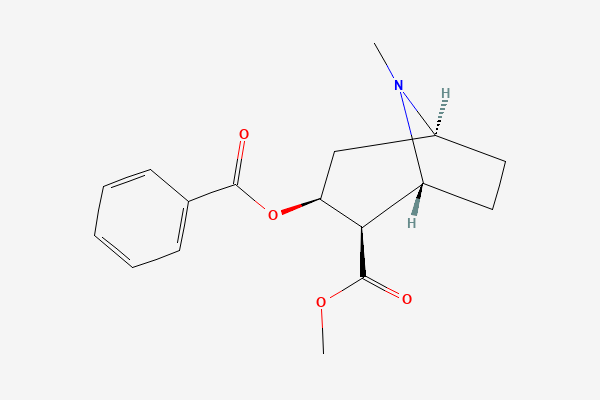
Cocaine molecular structure
PubChem
01

Overview

Cocaine has two clinically important chemical presentations. The free base is the neutral parent molecule; cocaine hydrochloride is a water-soluble salt used in the cited prescription nasal solution. The salt and free-base masses are therefore not interchangeable milligram-for-milligram. (pubchem, numbrino-label)

Its pharmacology combines monoamine-transporter inhibition with local-anesthetic sodium-channel blockade. Human PET work directly links striatal dopamine-transporter occupancy to the subjective cocaine “high,” while the prescription label attributes local anesthesia to reversible blockade of voltage-gated sodium channels. (volkow1997, numbrino-label)

How it works

Dopamine-transporter blockade

PET imaging in regular cocaine users found that IV cocaine 0.3–0.6 mg/kg occupied about 60–77% of dopamine-transporter sites; self-reported high correlated with transporter occupancy, linking DAT blockade to acute subjective effects in humans. [7]

Voltage-gated sodium-channel blockade

The U.S. cocaine-hydrochloride label describes reversible blockade of voltage-gated sodium channels, preventing transient sodium conductance and action-potential propagation; this accounts for topical local anesthesia. [2]

02

Subjective effects

Reported experiences are kept separate from measured outcomes and remain tied to their cited context.

Increased
Human research

Oral and IV cocaine produced qualitatively similar, dose-dependent increases in ratings including rush, drug effect, and liking; IV cocaine was approximately tenfold more potent across the study's measures. [5]

Population
Volunteers with histories of cocaine abuse
Exposure context
Oral 62.5–250 mg/70 kg or IV 12.5–50 mg/70 kg
Increased
Human research

Intranasal cocaine increased positive subjective-effect ratings with dose, but the second same-dose administration did not further increase positive ratings even though plasma cocaine approximately doubled. [6]

Population
10 experienced male cocaine users
Exposure context
Two intranasal administrations of 0.06–1.37 mg/kg, 40 minutes apart
03

Measured outcomes

What the research measured, for whom, and under which exposure. Findings remain attached to the study’s task or clinical endpoint.

In the pivotal randomized trial, anesthetic success occurred in 183/258 participants receiving 4% cocaine hydrochloride versus 25/127 receiving placebo; the 10% arm achieved 210/254. [2]

Population639 adults requiring diagnostic or surgical procedures involving accessible nasal mucosaExposureSingle 20-minute pledget application of 4% or 10% cocaine hydrochloride or placeboMeasureNPRS pain score of 0 at 20 minutes plus no additional anesthesia or analgesia during the procedure
Human research

Controlled oral/IV and intranasal studies found dose-related increases in heart rate and blood pressure; repeated intranasal dosing showed little additional cardiovascular response after the second dose despite approximately doubled plasma cocaine. [6]

Population10 experienced male cocaine usersExposureRepeated intranasal cocaineMeasureHeart rate and blood pressure
Human research

In a case-crossover analysis of 3,946 myocardial-infarction patients, nine reported cocaine use during the preceding hour; estimated MI-onset risk was 23.7 times baseline during that hour. [8]

Population3,946 patients interviewed after acute myocardial infarctionExposureSelf-reported cocaine use within 60 minutes before symptom onsetMeasureCase-crossover comparison with each participant's expected exposure frequency
Human research

Cocaine use within the preceding 24 hours was associated with early-onset ischemic stroke after adjustment for alcohol, smoking, and hypertension. [9]

Population1,090 ischemic-stroke cases and 1,154 controls aged 15–49 yearsExposureCocaine use within 24 hoursMeasurePopulation-based case-control interview and logistic regression
Human research

The same case-control study found no association for ever having used cocaine when acute timing was not considered; 28% of cases and 26% of controls reported ever use. [9]

Population1,090 ischemic-stroke cases and 1,154 controls aged 15–49 yearsExposureEver use of cocaineMeasurePopulation-based case-control interview
Human research

Among 43 emergency-department patients identified retrospectively with cocaine-associated seizures, 42 had a single tonic-clonic seizure and one developed status epilepticus. [10]

Population43 patients across 15 hospitalsExposureSuspected cocaine-associated seizure with cocaine-use history or positive urine testingMeasureRetrospective chart review
Limited research

Negative affect improved linearly and cocaine craving remained low over monitored abstinence; the investigators did not observe a phasic withdrawal syndrome or sleep disturbance in this outpatient sample. [11]

Population24 male and female cocaine-dependent outpatientsExposureMonitored cocaine abstinence for 28 daysMeasureSerial mood, craving, cognitive, sleep, and withdrawal assessments
Human research

Fetal growth

Decreased

In a prospective cohort restricted to full-term infants, models controlling for alcohol, tobacco, marijuana, and other covariates supported cocaine-associated fetal-growth deficits; there was no evidence of a disproportionate head-circumference effect after overall growth was accounted for. [12]

Population476 full-term neonates; 253 prenatally cocaine-exposed and 223 non-cocaine-exposedExposurePrenatal cocaine exposureMeasureStructural-equation and multiple-regression models
Human research
04

Doses & routes

Study doses and reference exposures, with route, formulation and duration.

Food timing and solubility labels describe the cited route or formulation. Solubility alone does not establish whether food changes absorption.

Intranasal · Through the nasal mucosa · 2 records

FDA-labeled topical nasal dose

Approved-label context

40–160 mg [2]

Ingredient / form
Cocaine hydrochloride · NUMBRINO 4% nasal solution
Route
Topical intranasal via pledgets
Frequency
Single procedure
Duration
Pledgets applied for 20 minutes
Population
Adults undergoing diagnostic procedures or surgery on or through accessible nasal mucosa
Purpose
Local anesthesia

Absorption context The label limits total dosing to 3 mg/kg per procedure.

Each mL contains 40 mg cocaine hydrochloride, equivalent to 35.7 mg cocaine free base.

Intranasal dose-response exposures

Research exposure

0.06–1.37 mg/kg [6]

Ingredient / form
Cocaine · Intranasal research cocaine
Route
Intranasal
Frequency
Two same-dose administrations 40 minutes apart per session
Duration
Acute laboratory sessions
Population
10 experienced male cocaine users
Purpose
Measure subjective, cardiovascular, plasma, and acute-tolerance responses

Studied doses were 0.06, 0.34, 0.69, and 1.37 mg/kg.

05

Pharmacokinetics

Absorption, metabolism and elimination depend on the analyte, route, formulation, physiology and other exposures.

Elimination half-life · Cocaine
About 1.15 hours in a pooled IV/intranasal/smoked study

Timing explorer

Published timing evidence
The source reports timing terms but does not provide numeric elapsed intervals.
Onset
Route-dependent. In a radiolabeled disposition study, the absorption half-time was 1.1 minutes after smoking and 11.7 minutes after intranasal administration.
Peak
Route-dependent; no single peak-time value represents intravenous, smoked, intranasal, oral, and topical nasal exposure.

Not established as a numeric timeline. Plasma timing and felt effects are distinct measurements. Source

Modeled elimination

The elimination model describes the named analyte after absorption and distribution. It does not establish felt-effect timing.

Intravenous · 40 mg IV cocaine · study-mean

Illustrative elimination model

Cocaine remaining over time

Single exposure

The modeled analyte is Cocaine. The curve begins after absorption and distribution; it does not predict onset, felt effects, or an individual’s response.

Route: Intravenous. Formulation: 40 mg IV cocaine. Population: 14 inpatient participants with current cocaine-use histories.

Mean half-life 1.1 hours; individual range 0.8–1.5 hours. Mean Cmax was 301 ng/mL. Read source context

Study mean: 1.1 hours.

The model uses this single study mean; no range is inferred.

The model treats this as the starting amount of Cocaine after absorption and distribution. It does not calculate bioavailability or conversion from another substance. Leave blank to view percentages.

Cocaine remaining (%)
Cocaine: illustrative elimination with a 1.1 hour half-lifeA first-order elimination model of Cocaine. 50% remains after 1.1 hours and 25% remains after 2.2 hours. Horizontal axis: elapsed hours after absorption and distribution. Vertical axis: percentage of the modeled analyte remaining. This is a mathematical illustration, not a personalized prediction.02550751000 h1.1 h2.2 h3.3 h4.4 h5.5 h
ElapsedRemaining
After 1.1 h50% remains
After 2.2 h25% remains
After 5.5 h3.125% remains

Model: fraction remaining = 2−time / half-life. Assumes a single exposure, instantaneous distribution, and a constant half-life for Cocaine. Formation of metabolites, repeated exposure, and interactions are not modeled. Read source context

In 16 subjects divided by intravenous, intranasal, or smoked administration, the elimination half-life calculated from the average rate constant was 69 minutes; IV elimination half-life was 78 minutes. Route- and formulation-specific estimates are retained below. [3]

Sourced elimination observations

Cocaine

Study mean

1.15 hours [3]

Route / formulation
Intravenous, intranasal, and smoked · Radiolabeled cocaine
Population
16 subjects divided among three administration-route groups

Half-life calculated from the average elimination-rate constant was 69 minutes. IV elimination half-life was 78 minutes; smoked absorption half-time was 1.1 minutes and intranasal absorption half-time 11.7 minutes. Intranasal bioavailability was 80%.

Cocaine

Study mean

1.1 hours [4]

Route / formulation
Intravenous · 40 mg IV cocaine
Population
14 inpatient participants with current cocaine-use histories

Mean half-life 1.1 hours; individual range 0.8–1.5 hours. Mean Cmax was 301 ng/mL.

Cocaine

Reported range

1.2–1.3 hours [4]

Route / formulation
Oral · 100 mg and 200 mg oral cocaine
Population
14 inpatient participants with current cocaine-use histories

Mean half-life was 1.2 hours after 100 mg and 1.3 hours after 200 mg; mean Tmax was 1.3 hours for both. Mean bioavailability was 32% and 45%, respectively.

Cocaine

Study mean

1.54 hours [2]

Route / formulation
Topical intranasal · NUMBRINO 4% cocaine hydrochloride solution via pledgets
Population
Healthy adults

After 160 mg cocaine hydrochloride applied for 20 minutes, estimated systemic absorption was 23.44%, mean Cmax 142.68 ng/mL, median Tmax 30 minutes from pledget insertion, and apparent elimination half-life 1.54 hours.

Bioavailability
Intranasal bioavailability was about 80% in the radiolabeled disposition study; observed smoked bioavailability was reduced by thermal degradation. In a later within-subject study, mean oral bioavailability was 32% after 100 mg and 45% after 200 mg. [3]
Metabolism / metabolites
Hydrolysis produces benzoylecgonine and ecgonine methyl ester as major metabolites; the U.S. label also describes minor CYP3A4 formation of active norcocaine. [3]

Factors that change the estimate

Route of administration

Systemic delivery rate varies markedly by route.

In the radiolabeled study, smoked cocaine had a 1.1-minute absorption half-time versus 11.7 minutes intranasally; intranasal bioavailability was about 80%, while thermal degradation reduced observed smoked bioavailability. [3]

Related observation

Oral dose

Oral bioavailability differed between the two studied doses.

Mean oral bioavailability was 32% after 100 mg and 45% after 200 mg in the same 14 participants. [4]

Related observation
06

Safety & uncertainty

Adverse effects and interactions reported in the cited studies.

Warning

Cardiovascular toxicity

Cocaine raises heart rate and blood pressure and can produce myocardial ischemia, infarction, and arrhythmias. The label warns that serious cardiovascular reactions have occurred, while the case-crossover study found a large but imprecise transient increase in MI-onset risk after recent use. [8]

Monitor

Neurologic toxicity

Seizures are a recognized cocaine complication. A 43-patient multicenter retrospective series found most identified cocaine-associated seizures were single self-limited tonic-clonic events, but status epilepticus occurred in one patient. [10]

Context

Psychiatric and dependence risk

The current prescription label carries a boxed warning for abuse and dependence and describes euphoria, excitation, anxiety, irritability, paranoia, confusion, and psychosis among effects associated with abuse; repeated misuse can produce physical dependence. [2]

Warning

Abstinence and withdrawal uncertainty

Prospective 28-day monitoring of 24 cocaine-dependent outpatients found improving negative affect and low craving without a clear phasic withdrawal syndrome or sleep disturbance, showing that withdrawal trajectories are not uniformly stereotyped. [11]

Monitor

Pregnancy

The prescription label states that data from a single medically applied topical dose are insufficient to determine pregnancy risk. Observational chronic-exposure literature is confounded by coexposures; a prospective cohort nevertheless found an adjusted fetal-growth association, while finding no disproportionate head-circumference deficit after overall growth was modeled. [12]

Context

Evidence does not define a nonmedical safe dose

Human laboratory studies used screened participants, controlled formulations, monitoring, and predefined cardiovascular stopping criteria; their administered doses do not establish safety for unregulated formulations, repeated binges, or polysubstance exposure. [4]

Interactions in cited sources

Explore a pair of substances

Ethanol (alcohol)

In eight experienced nondependent volunteers, 100 mg intranasal cocaine plus 0.8 g/kg ethanol produced greater heart-rate, rate-pressure-product, euphoria, and well-being responses than cocaine alone and generated cocaethylene and norcocaethylene. [13]

Mechanism
Ethanol alters cocaine metabolism and permits formation of cocaethylene; pharmacodynamic interaction may also contribute.
Context
Double-blind, double-dummy randomized crossover study; sample size was eight.
Severity in cited source
Increased cardiovascular exposure and effect in controlled human study [13]

Disulfiram

The current label reports that disulfiram increased cocaine AUC and Cmax several-fold after acute intranasal exposure and increased AUC after IV exposure. [2]

Mechanism
Reduced cocaine metabolism and increased systemic exposure are described in the label.
Context
Label interaction based on published human literature.
Severity in cited source
Substantial pharmacokinetic interaction [2]

Epinephrine and phenylephrine

The label reports myocardial ischemia, myocardial infarction, and ventricular arrhythmias with concomitant vasoconstrictor use and cocaine during nasal or sinus surgery. [2]

Mechanism
Additive sympathomimetic and vasoconstrictor effects.
Context
Label warning based on reported clinical events; incidence is not established.
Severity in cited source
Serious cardiovascular interaction [2]

Other CNS stimulants, tricyclic antidepressants, and monoamine-oxidase inhibitors

The label describes potential amplification of sympathetic or CNS-stimulant effects, including hypertension, arrhythmias, nervousness, irritability, or convulsions depending on the interacting class. [2]

Mechanism
Additive or potentiated monoaminergic and sympathomimetic activity.
Context
Regulatory interaction warning; quantitative interaction magnitudes are not established in the label.
Severity in cited source
Potentially clinically significant [2]
07

Research & sources

14

Original publications, findings and available funding disclosures.

08

Connected claims

Explore the participants, roles and sources behind each relationship.

transporter-occupancyAuthored relationship

Intravenous cocaine occupies the human dopamine transporter, and occupancy is associated with the magnitude of the subjective high.

Cocainesubstance
Dopaminetransmitter

PET study in regular cocaine users receiving IV cocaine 0.3–0.6 mg/kg.

Limitation Small laboratory imaging study; it establishes an acute exposure-response relationship, not a complete mechanism of dependence or toxicity.

local-anesthetic-actionAuthored relationship

Topical cocaine hydrochloride can produce local nasal anesthesia through sodium-channel blockade.

FDA-labeled topical nasal use in adults.

Limitation Approved topical use does not establish benefit for systemic or nonmedical routes.

acute-exposure-associationAuthored relationship

Recent cocaine exposure is associated with higher odds of early-onset ischemic stroke, whereas ever-use alone was not associated in the same study.

Cocaineexposure
Strokeoutcome

Population-based case-control study of people aged 15–49 years.

Limitation Cocaine exposure was self-reported and acute-exposure counts were small, producing wide confidence intervals; association does not by itself prove individual-event causation.

clinical-benefitAuthored relationship

In the pivotal labeled trial, 4% cocaine hydrochloride produced more protocol-defined nasal anesthetic success than placebo.

Cocaineintervention

Single topical pledget application before nasal diagnostic or surgical procedures.

Limitation Patients with important cardiovascular disease or uncontrolled hypertension were excluded, and placebo participants did not proceed to the procedure after unblinding.

Explore the relationship graph
10

Publication history

Content updated Oct 16, 2026.

Keep exploring

View graph